

By SONG Jianlan
Recently, an exceptionally preserved fossil specimen of a gravid ichthyosaur referred to Mixosaurus panxianensis caught the eye of paleontologists—unearthed from deposits dating to around 244 million years ago, this aquatic reptile carried as many as 11 fetuses! This represents the largest litter size of viviparity ever seen in Triassic ichthyosaurs, or even all ichthyosaurs—the only comparable litter size did not appear until ~60 million years later in Jurassic Stenopterygius, another ichthyosaurus genus, which tied with this record.
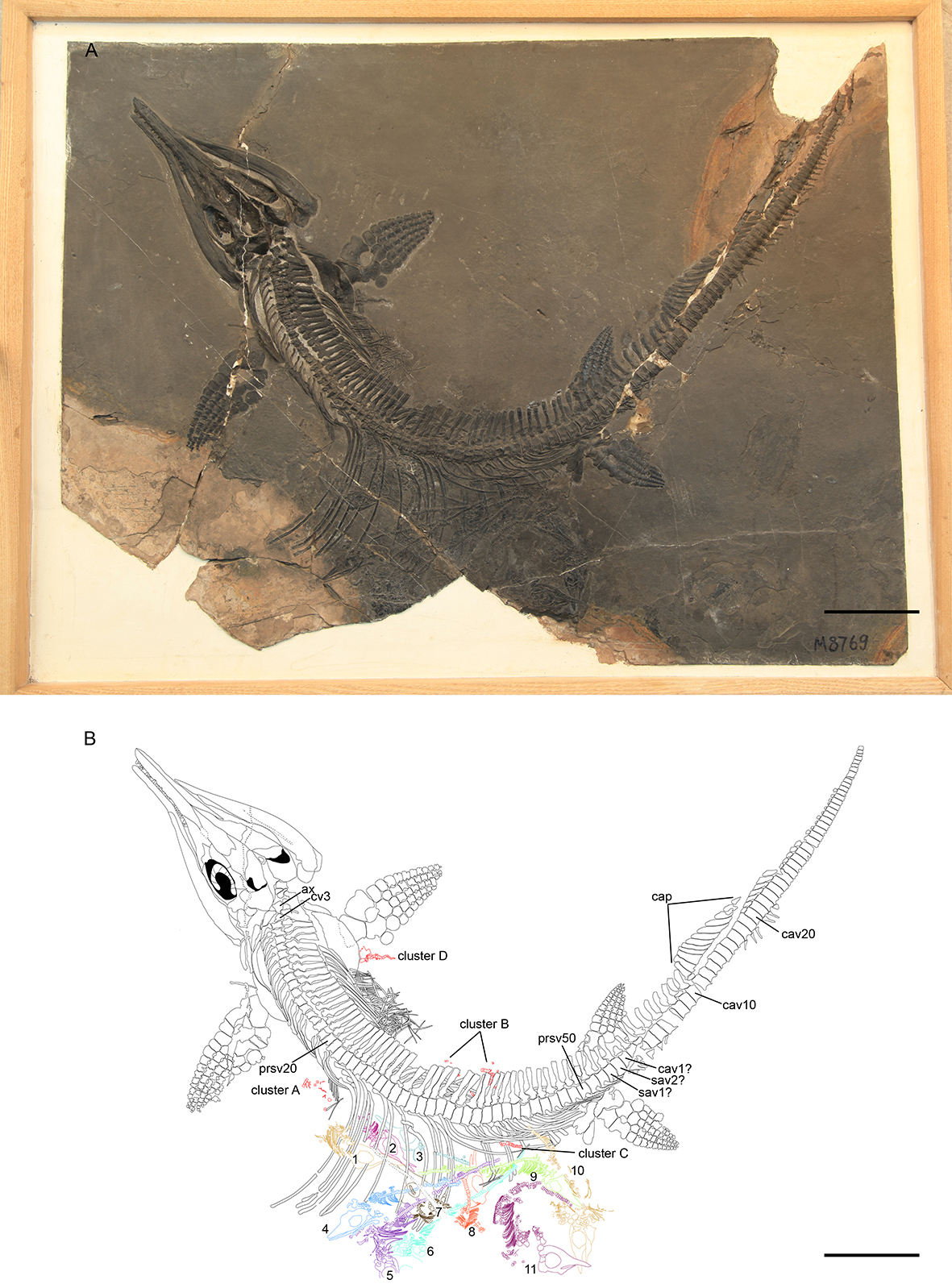
The specimen of a gravid Mixosaurus panxianensis with a total of 11 fetuses. (Credit: IVPP)
A team led by Dr. WANG Wei, a paleontologist from the Institute of Vertebrate Paleontology and Paleoanthropology (IVPP), Chinese Academy of Sciences reported this discovery in PeerJ, an international journal. Unearthed from the early Middle Triassic strata of Guizhou Province, southwestern China, the specimen is now housed at the Zhejiang Museum of Natural History (ZMNH), and hence labelled as ZMNH M8769. It not only demonstrates that highly fecund viviparity emerged early in the evolutionary history of ichthyosaurs, but also indicates a possible reproductive strategy that might have helped this genus thrive and dominate the Mesozoic ocean.
Predation or Vivparity?
But could this actually be something else mistaken for viviparity, say predation relic? The researchers carefully analyzed the morphology of both the adult and the fetal Mixosaurus, and differentiated the fetuses from possible predatory remains. All fetuses were essentially located in the abdominal cavity of the adult; all of them were well-articulated, without digestive erosion. Six out of the 11 fetuses remained almost fully within the uterus of the mother ichthyosaur, with the other five scattered outsides—probably by explosion of decomposition gases after the death of the adult. All these direct to a viviparity rather than predation relic. Moreover, all the fetuses were well developed, near to a prenatal or perinatal stage, indicating consistency in development.
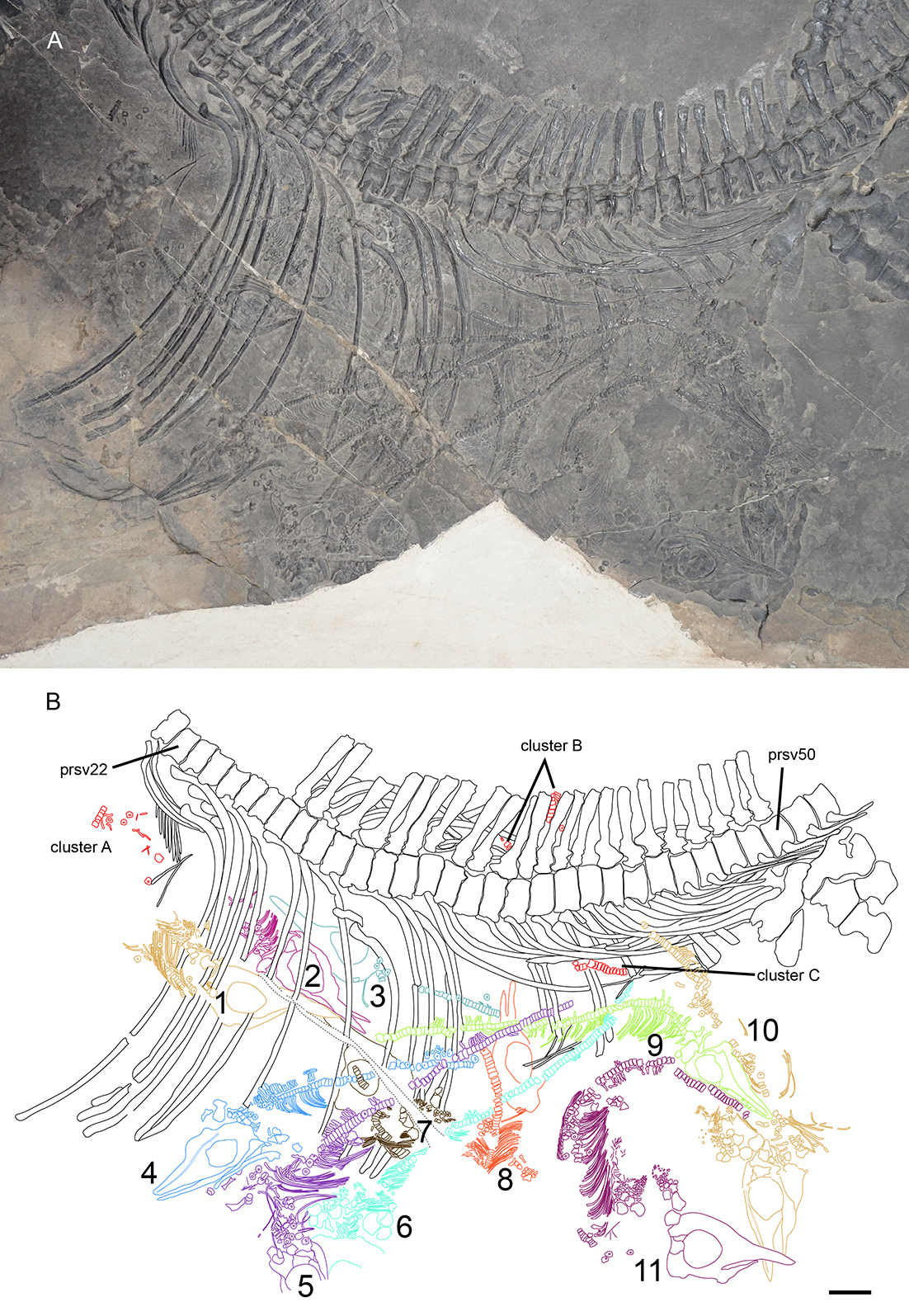
The detail of the abdominal part of the specimen, with the 11 fetuses each clearly differentiated with numbers and colors. An explosion of decomposition gases might have thrown part of them outside the uterus. (Credit: IVPP)
Outstanding Litter Size
This preeminent litter size, emerging from the early Middle Triassic, suggests that ichthyosaurs had evolved the capability of high fecundity shortly after the origin of this order. Further, this high fecundity indicates that Mixosaurus might lean on a reproductive strategy called r-selection: in contrast to K-selection, this strategy tends to produce a large number of offspring and invest minimal parental caring. This reproductive strategy might have contributed to the domination of Mixosaurus in the Triassic seas as one of the most successful ichthyosaur genera of the Mesozoic—abundant fossil remains discovered across the world tell the story. Still, however, the authors cautioned, more specimens with such a large number of fetuses are needed to further confirm this hypothesis.
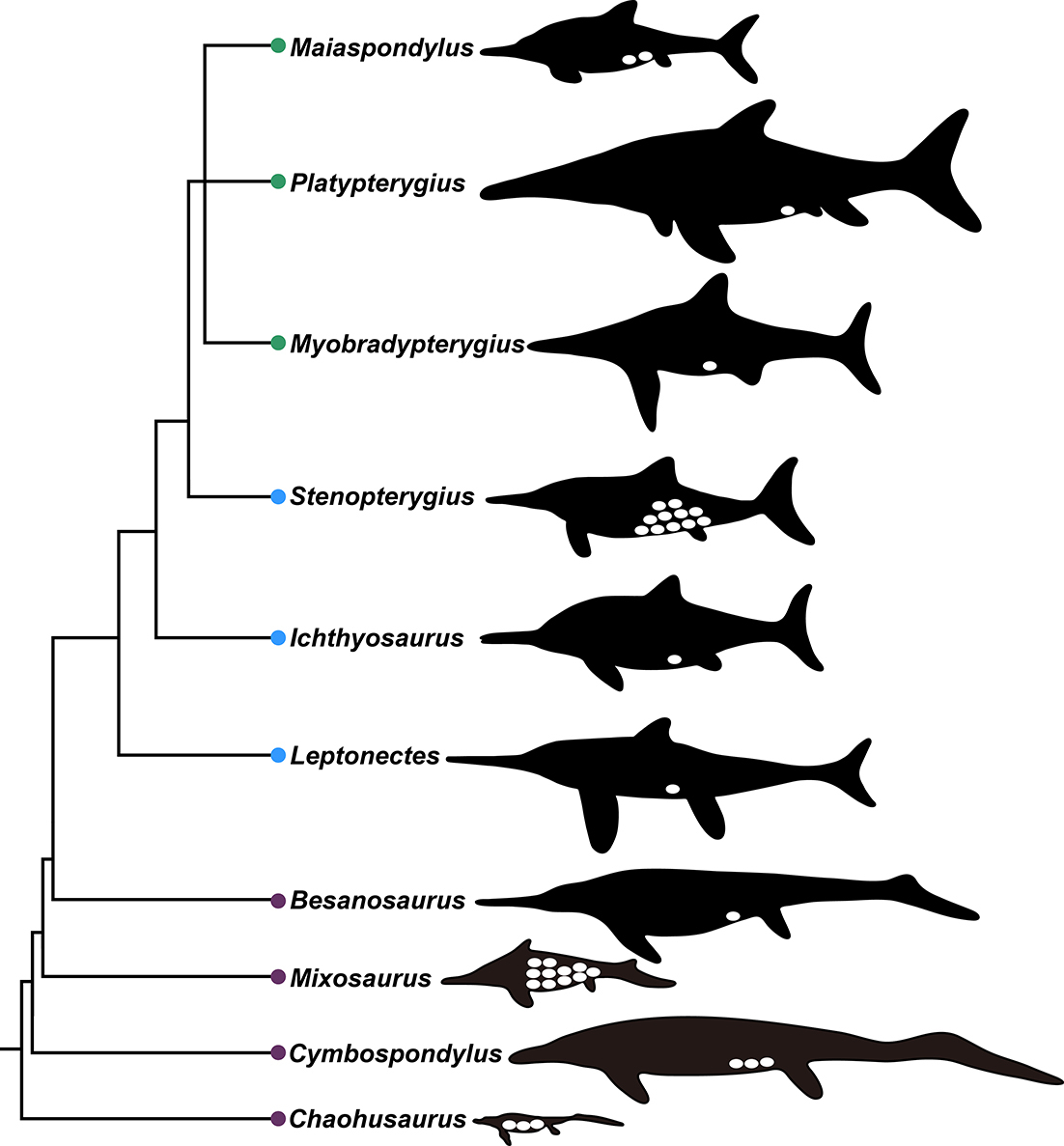
The biggest litter size (indicated with white dots in the abdomen) ever known, represented by the Mixosaurus specimen ZMNH M8769, emerged in the Middle Triassic, when the ichthyosaurus was undergoing quick divergence. (Credit: IVPP)
Actually, in the case of its rival genus Stenopterygius, the number of preserved fetuses varies in different individuals, with most cases giving one to three fetuses and merely one single specimen giving 11 ones. Therefore, the authors analyzed, a litter size as big as 11 could be an extreme case for Stenopterygius, and their reproductive behavior might be subject to their physical condition and environmental factors. So could be the case for the newly unearthed female individual of Mixosaurus.
Nevertheless, this discovery demonstrates that a high fetal-carrying capacity during a single pregnancy, exceeding ten individuals, evolved early in ichthyosaur evolution, as evidenced here in the Middle Triassic Mixosaurus.
Viviparity as an Advantage
One might be surprised by the episode of ichthyosaurs giving live birth—shouldn’t dinosaurs be oviparous?
Yes, but not all of them.
Actually, a descendent from land-dwelling reptiles, ichthyosaurus was among the first tetrapods to evolve viviparity. The oldest known fossil gravid ichthyosaur, a Chaohusaurus, is from the Early Triassic strata, dating around 248 million years ago. This suggests that almost immediately after or even before their return to the ocean, they evolved this new trick.
The Early to Middle Triassic was a highly competitive and dangerous time for marine reptiles—The oceans were recovering from the Permian-Triassic mass extinction (the “Great Dying”), and many new groups were vying for ecological dominance. At this critical time, this new ability might have helped the genus survive and thrive.
After their venturing back into water, ichthyosaurus evolved fin-shaped limbs and streamline tails—highly adept at swimming in water, yet clumsy locomoting on land. In this situation, laying eggs back on the coasts and leaving them unattended, would risk devastation of the eggs, and even cost the lives of the pregnant adult females themselves—they could fall victims of predators. Giving live birth in water, retaining the fetuses inside the parental body until they fully developed to an extent capable of swimming in the ocean, could have improved the chances for survival, and hence helped ichthyosaurus survive to pass on their genes.
Plesiosaurs, another highly aquatic reptilian clade, also evolved viviparity ability. Nevertheless, they adopted a reproductive strategy sharply different from the r-selection taken by Mixosaurus, producing fewer offspring and giving intensive parental care—known as K-selection.
Therefore, viviparity with high fecundity could be an evolutionary adaptation to their new living environment and aquatic life. Resulting from the competition in the water, ichthyosaurs flourished, diversified, and spread across the world in the Mesozoic seas.
Reference
Gu S, Wang W, Li X, Li C. (2026) High fecundity in an early-diverging ichthyosaur with over ten fetuses. PeerJ 14:e21620 http://doi.org/10.7717/peerj.21620