

The Tan Kah Kee Science Award in Technological Sciences is conferred to the “Principle, technology, and applications of light-weight and heat-resistant TiAl single crystal for aerospace power”, a research accomplished by a team from Nanjing University of Science and Technology (NJUST) led by Prof. CHEN Guang, a Member of the Chinese Academy of Sciences, and Profs. QI Zhixiang and CHEN Yang. The team invented an innovative method to control the nucleation orientation of complicated crystals during their growth, and revealed the underlying physical principles. They successfully produced a light-weight and heat-resistant TiAl single-crystalline material for high-performance aero-engines, and their technology has remained the only feasible way so far to produce such materials with desirable combination of ambient- and high-temperature performance.
Challenges for Aerospace Materials
In flight, the blades of an operating aero-engine must maintain excellent mechanical properties, in the face of the hot turbulence created by the engine itself—in this situation, the temperature of the engine could easily go beyond 700°C. This has posed demanding requirements on the blade material. Meanwhile, this material needs to be as lightweight as possible—for an aero-engine, every gram of its own weight affects the lift coefficient. As a physical law, however, the lower the density of a metal, the lower its melting temperature; this puts high-temperature strength and lightness well at the two ends of a paradox.
In comparison with nickel-based superalloys, TiAl alloys are half as dense; and they demonstrate decent corrosion resistance and good mechanical properties when exposed to high temperatures. Therefore, TiAl intermetallic alloy in polycrystalline structures has been applied to gas turbine engine blades in place of Ni-based superalloys for service temperatures ranging from 600°C to 650°C. This replacement has led to a weight reduction of about 50%. So far, it has been widely used in GEnx 1B engine for Boeing 787, reaping significant decreases in oil consumption, noise and CO2 emissions.
Unfortunately, this family of materials has some intrinsic drawbacks due to their compositions and structure. Their ductility is not good enough at ambient temperature; this makes them brittle in the face of stresses. Moreover, they cannot sustain good performance for a long enough time at high temperatures. These bottlenecks have prevented their wider applications in aeronautic and aerospace industries.
To improve their mechanical properties and raise their service temperature when applied to gas-turbine engines, the most effective way known is to use single crystals in which atoms are well-aligned at certain crystalline orientations. For example, polysynthetic twinned (PST) TiAl single crystals with parallel lamellar orientations. However, it is challenging to control the growing orientation of the lamellae. Traditionally, the only known way to produce such crystals was a set of costly seed-based directional solidification methods.
The Unruly Crystal Lattice
A major difficulty in growing such well-aligned structures in PST single crystals rises from the mismatch between the natural lamellar orientation and the preferred one for the primary α phase directionally solidified alloy: The two are perpendicular to each other. A traditional solution is to introduce “seeds”—prepared seeding crystals with preferred crystalline orientation—to the casting process, and let the seeds guide the atoms in the liquid alloy to nucleate along certain orientations. Such methods, however, only work on a narrow range of compositions, and often produce misoriented crystals due to the unpredictable phase crystalline orientations. More frustratingly, the produced crystals fail to achieve adequate ambient-temperature ductility, nor can they sustain good performance for a long time at high temperatures. Like a structural ceiling, such difficulties blocked the microstructure improvement for a long time.
As a compromise, most TiAl alloys sacrificed room-temperature toughness, leaving the ambient-temperature ductility at a low level of less than 2%.
This remained unchanged until the prize-winners came with a new technology. They not only invented a novel way to grow the crystals at selective orientations without seeding, but also explained why and how the new method works.
Emergence of the Novel Material
Profs. CHEN Guang, QI Zhixiang, CHEN Yang and their colleagues optimized both the ambient ductility and the high-temperature performance of the alloys. They adjusted the compositions of the alloys to reduce the stacking fault energy and enable nano-twinning; further, they developed a novel seedless method to produce PST TiAl single crystals with desirable room-temperature tensile ductility and excellent yield strength at high temperatures.
The team reported their results in a paper published in Nature Materials in 2016. The new materials they produced, could exhibit a yield strength of 637 MPa at 900°C with an 8.1% ductility; and at ambient temperature, it could stand a pressure of 735 MPa, demonstrating a ductility of 6.3%~7.6%, in contrast to the typical ambient-temperature ductility of less than 2% for traditional polycrystalline-structure TiAl alloys. The new material grown with controlled orientations demonstrated far superior creep resistance compared with the commercial Ti-48Al-2Cr-2Nb (4822) alloy. Particularly, the new material can stand 150 MPa at 900°C for 363 hours, one order of magnitude better than the 4822 alloy.
With this combination of strength, ductility, and creep resistance, the new material can achieve a service temperature up to about 900°C, substantially higher than conventional TiAl alloys, whose service temperature ranges from 600°C to 650°C. This improvement has enabled new applications in hotter sections of jet engines.
How did they make it?
Taming the Lattice
Drawing on their own experiments and the existing literature, the team reckoned that both microstructure and alloy composition could play an important role in improving the ambient-temperature ductility. Therefore, they accordingly adjusted the niobium (Nb) content in the alloy composition, and invented a seedless method to grow PST single crystals with well-aligned lamellar microstructure.
In the traditional growing methods, the seeding could guide the nucleating orientation for TiAl alloys that mainly nucleate in a certain phase (α-solidification), but it failed in cases where another phase, the β-solidification dominates. The latter, upon cooling, would spontaneously convert the generated β-type crystals into α-types—randomly oriented along 12 different directions between 0° and 45°. This uncertainty leads to misorientation in the grown lamellae; even seeding can do nothing for rescue.
To better align the lamellae, the NJUST team controlled the orientation during the β-α transformation through regulating the interfacial anisotropy. After careful calculation, they discovered the subtle difference in energy needed for different orientations. For example, the planar disregistry of the 0°-directed interface is 3.2% lower than that of the 45° one. Exploiting such nuances, they controlled the withdrawal rate during solidification, and grew PST single crystals with parallel lamellae at selective orientations—without seeding.
Therefore, they overcame a long-standing barrier to produce low-cost PST TiAl single crystals without seeding. With their well-aligned microstructure, could they withstand the harsh conditions an aero-engine would face as a routine? The team proceeded to test and measure the new material’s properties in different environments.
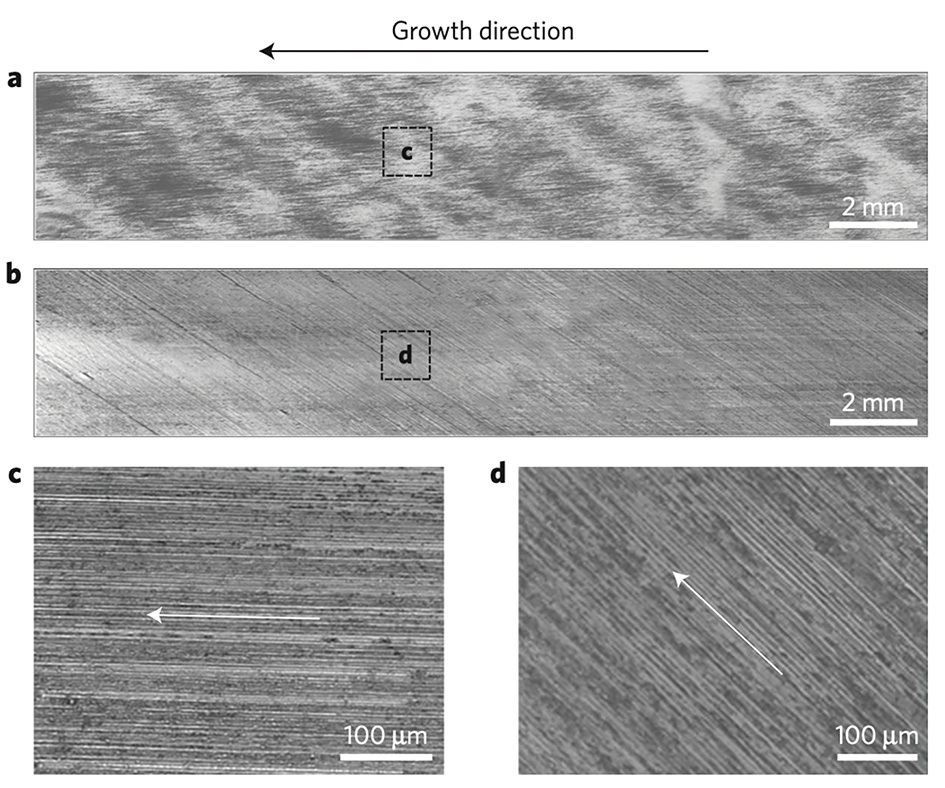
The researchers found that at different withdrawal rates, TiAl can solidify into PST single crystals in certain orientations. Shown are optical micrographs of TiAl PST single crystals directionally solidified at different withdrawal rates. a, A PST single crystal grown at a withdrawal rate lower than a certain velocity Vc , with its lamellae oriented parallel to the growth direction. b, A PST single crystal grown at a withdrawal rate higher than a certain velocity Vc , with its lamellae orientated at 45◦ to the growth direction. c, Magnified lamellar microstructure in the area marked in a, showing more clearly the parallel lamellar microstructure. d, Magnified area marked in b. (Image by NJUST)
Unusual Ambient-temperature Ductility
How ductile could this material be under ambient temperature? To test its ductility, the team conducted tensile experiments on the samples, and made theoretical simulations. For well-aligned alloys of 0°-orientation, the tensile ductility reached as high as 7.6%, and the yield strength reached 735 MPa. The PST single-crystalline alloys produced with the new method demonstrated a superior tensile ductility of 6.3%~7.6% in general, far better than the previously known TiAl alloys.
Under transmission electron microscopy (TEM), the team carefully observed the as-cast crystals to examine the dislocations in their microstructure before and after the tensile deformation. They found that refined nano-twinned structures with a twin thickness of about 10 nanometers were formed essentially during the plastic deformation in response to the stretch—the space in the coarse structure of the as-cast crystals was refined to form denser twins. A similar nano-twinned structure, as found in previous research of nano-structure copper, has “huge advantages” and can enhance the metal’s strength without loss of ductility. Could it also play some role here?
After testing the strength changes with the strain, the team concluded that both dislocation slips and twinning deformation took place during the plastic deformation in process of the tests at ambient temperature. The twinning-controlled deformation operated in the middle stage of the deformation had resulted in a high tensile ductility at room temperature. The twinning nucleation during the growth of the crystal has allowed the partial dislocation of the lamellae as well as the formation of intrinsic stacking faults. Increased content of Nb also played a key role—it reduced the stacking fault energy and let the dislocation slips happen more easily to form dense twins during the plastic deformation.
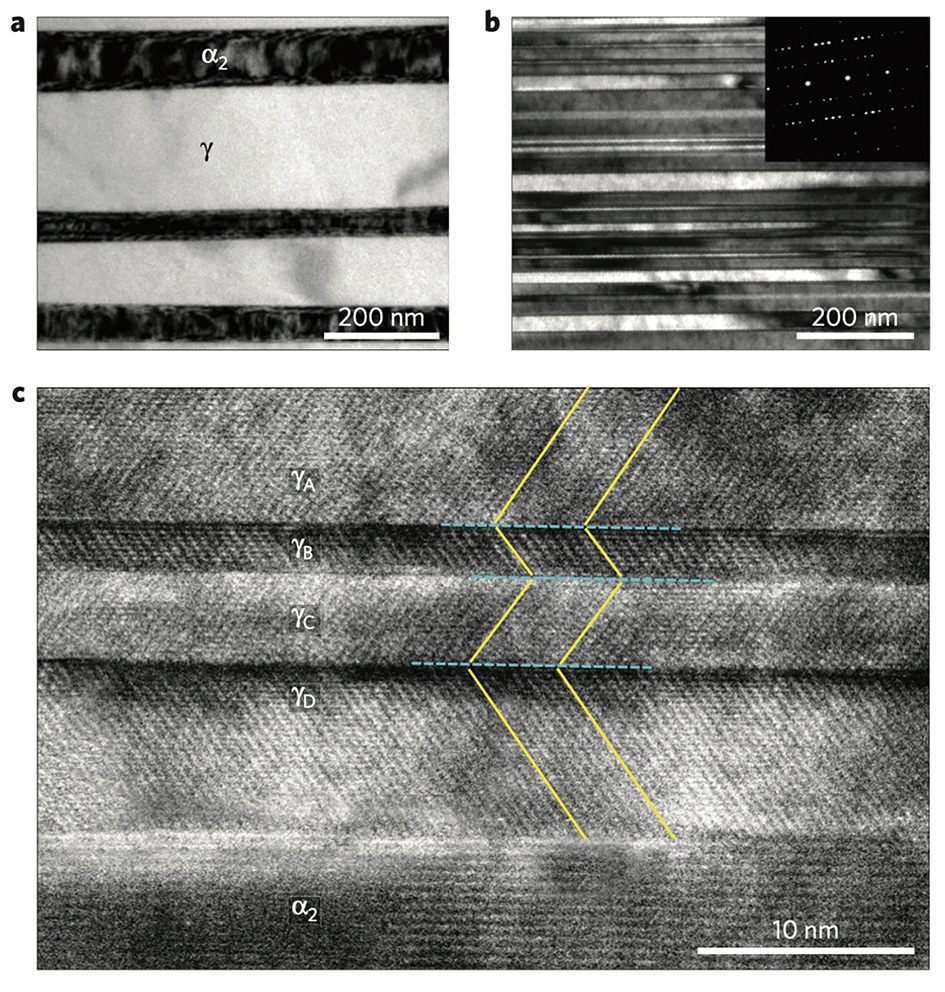
Lamellar microstructure of a TiAl well-aligned PST single crystal before and after tensile test at ambient temperature.
a, Bright-field TEM image of a tensile specimen showing the original α2/γ lamellar structure before the test. b, After the tensile deformation, the bright-field TEM image reveals the ultrafine twinning and lamellar structure, with the selected area electron diffraction pattern (inset). c, A high-resolution TEM image of the deformed specimen showing multiple-twinned structures containing three twin boundaries γA/γB, γB/γC and γC /γD. (Image by NJUST)
At this point one might ask, however, with such “unusually large” ambient-temperature ductility, what would happen at elevated temperatures? Could it soften and deform a lot, hence failing to stand the hot turbulence while working as engine blades?
Unique Combination of Properties
The team was surprised to find that there was no sharp decrease in the yield strength of the new material from ambient temperature throughout 900°C. It maintained excellent performance at high temperatures, until a sudden snap at 1,000°C—far beyond the service temperature range (650°C~820°C) as usually observed in traditional TiAl alloys.
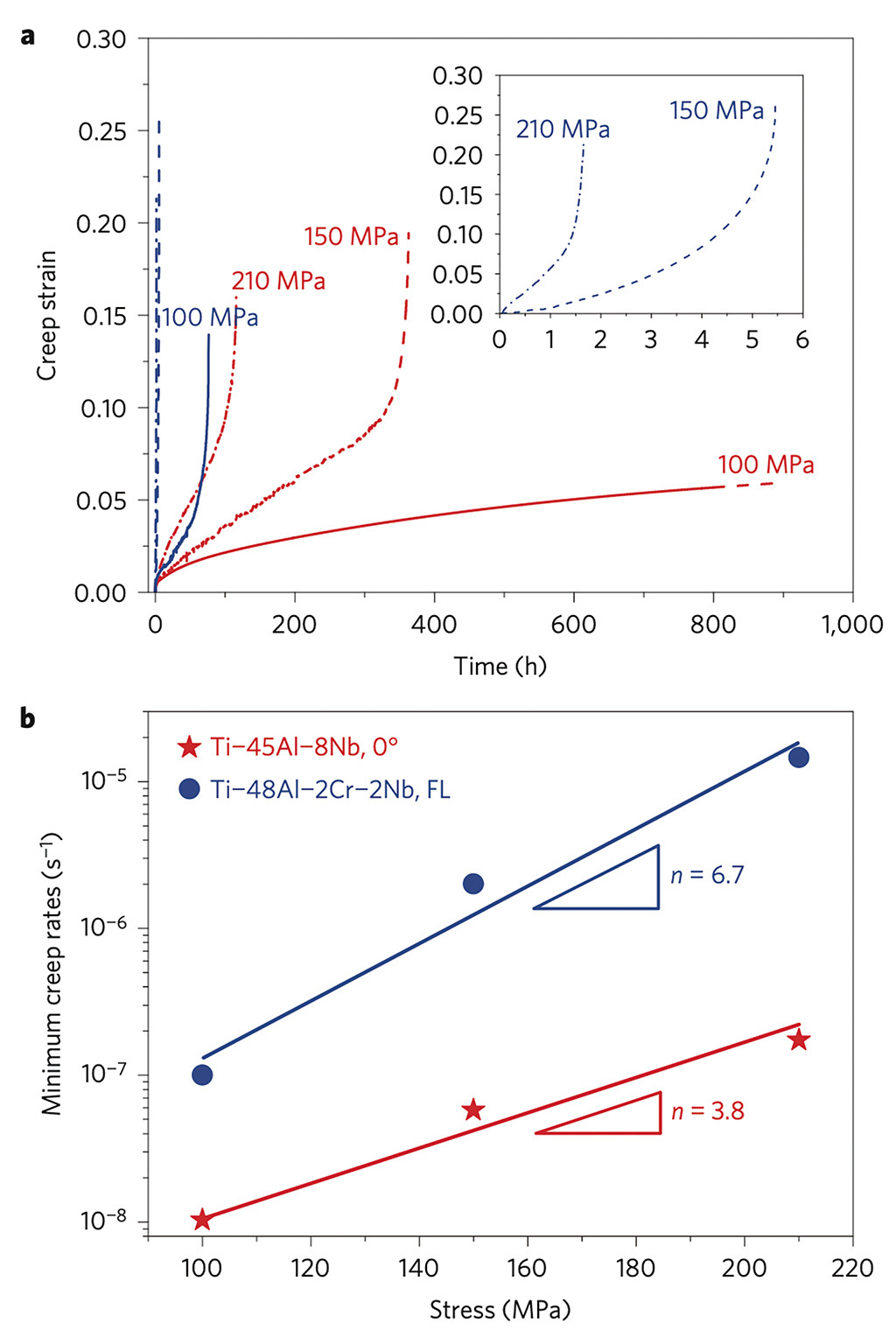
Creep properties of the new material with the 0° lamellar orientation (red line) in comparison with those of 4822 alloys (blue), tested under different stresses at 900°C in air. (a), The maximum lifetimes of the new materials, at different creep strains, are much longer than 4822 alloys. (b), The minimum creep rates of the new materials are much lower than 4822 alloys; and the steeper slope of the latter indicates its sensitivity to the load conditions. (Image by NJUST)
Moreover, in the face of elevated temperatures, the new material demonstrated excellent creep resistance and structural stability, both important for high-temperature applications. Under constant stresses of 150 and 210 MPa at 900°C in air, the new material remained steady for 363 and 116 hours, respectively—66 to 68 times longer than those of the 4822 alloys. While under 100 MPa, the new material maintained steady up to 800 hours, in sharp contrast to the 76.4 hours of 4822 alloys under the same conditions.
Therefore, the team solved a long-standing dilemma and well balanced the mechanical properties at both high-temperature and ambient-temperature circumstances, securing the steady performance of the material at different temperatures. Based on the excellent mechanical properties of the new material, the team concluded that it can meet the requirements for aero-engine blades at a service temperature as high as 900°C.
Outstanding Fatigue Resistance
The story did not end here. For a rotating turbine, where the blades experience cyclic loading, high-temperature fatigue life is also important. In fact, fatigue rather than static tension or creep deformation, is the primary failure mode for turbine blades in service. Given the neat microstructure as well as the excellent properties, the team expected that the new material probably have very good fatigue resistance.
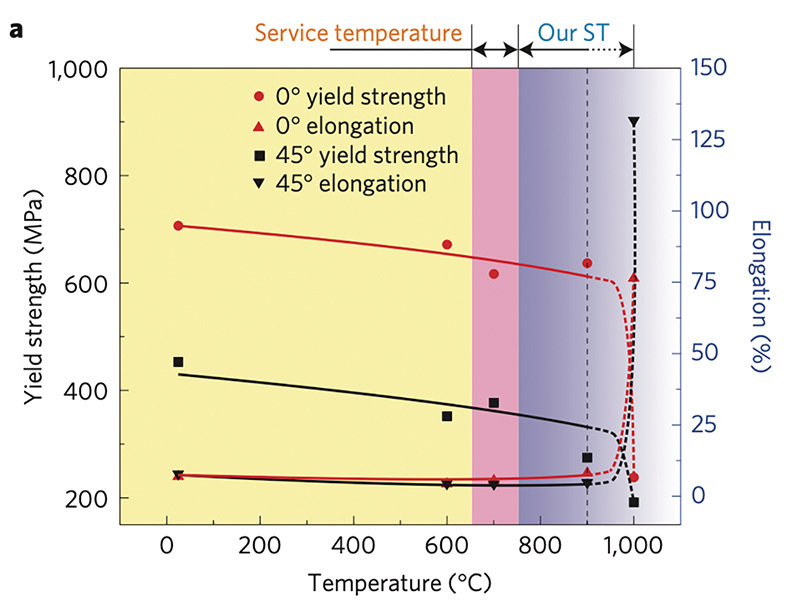
Tests indicate that the new material boasts an excellent combination of mechanical properties, meeting the requirements for aero-engine blades at a service temperature as high as 900°C. (Image by NJUST)
They did not have the opportunity to test and really know until years later; and when they did have, they further revealed an interesting mechanism—intrinsic to the well-aligned twinned microstructure—that greatly helps improve the fatigue resistance of the materials.
The team systematically characterized the high-cycle fatigue behavior of the PST TiAl single crystals at 975°C, a temperature even higher than the one set for the creep resistance experiment, and reported their discoveries in a paper published in Journal of Materials Science and Technology in May 2021.
As a result, they found that the crystal could withstand over 10 million cycles of loading at 975°C under a stress amplitude of 270 MPa, far better than conventional TiAl alloys.
To understand the mechanism underlying this excellent high-temperature fatigue resistance, the team examined the deformation substructure after the fatigue tests through an advanced TEM. They found that the plastic deformation was evenly distributed among all the lamellae—grown in different phases alike, with each enduring an equally sufficient load.
As seen under the TEM, a large number of stacking fault structures formed across all lamellae—in response to the cyclically loaded stress, plastic deformation occurred to them and produced these uniform structures. Surprisingly, even the hard lamellae nucleated at room temperature with difficult slippage—the defiant α2 lamellae—joined this chorus. What has driven them into this impossible plastic deformation?
A Magical Cycle
The team made atomistic dynamics simulations based on the observed deformation. Detailed thermodynamic analysis uncovered a previously unknown mechanism underlying this chorus. The cyclic strain, periodically concentrated on the γ/α2 interfaces, triggered a pyramidal dislocation. It was not stable—it spontaneously split into two secondary dislocation reactions that penetrated the α2 lamellae. Of them, the dominant one produced a sandwich structure composed of two Frank partial dislocations and one ribbon of “I1” stacking faults. The Frank partial dislocations, while occurring in the α2 lamellae, accommodated a large amount of strain with its own plastic deformation; and the “I1” stacking faults, posing for the upcoming cycle of strain, would produce a further wave of pyramidal dislocations when the strain struck in... This formed an unlimited cycle when the loading repeated, continuously receiving and uniformly distributing the incoming strain across the lamellae.
Therefore, the improvement could be attributed to the uniform lamellar structure of the crystals. In the face of stress, the uniformly aligned atoms allowed the stress to distribute evenly across them, each sustaining a part of the load—just like a rope, every strand in it stands a share of load. As a sharp contrast, in a traditional polycrystalline TiAl alloy, where lots of atoms are misoriented, the plastic strain would have no way to go but to localize on a small number of γ lamellae, hence the accumulated stress would concentrate on the γ/α2 interfaces. Once the concentration built up to a critical point, the whole structure would break along the crystalline boundaries—cracks would appear and propagate, leading to material failure.
Smashing the myth that α2 lamellae could not deform plastically enough to accommodate cyclic strain, the PST single-crystal microstructure demonstrated excellent fatigue resistance.
The new technology has been verified and applied to different alloy systems including TiAl, FeAl and NiAl families. Recognizing its far-reaching implication, the journal Nature connected it with China’s goal to become a leading S&T power by 2049; and Nature Materials highlighted this technology in a commentary for its special topic, highlighting its significant contributions to the extensive applications of TiAl alloys at higher temperatures.
The team’s research papers have been widely cited by international scholars from 568 universities and institutes of 45 countries, including prestigious academicians. Among them, the “news and views” of Nature Materials commented the advance as “going beyond current application limits,” highlighting that “the work of Chen et al. offers a significant contribution towards more widespread use of TiAl alloys at high temperatures”. Prof. Fritz Appel (Helmholtz-Zentrum Geesthacht, HZG) promoted this technology on the cover of his monograph titled Gamma TiAl Alloys Science and Technology. Prof. Chandan Mondal (Defense Metallurgical Research Laboratory, DMRL), a well-known metallurgist, commented that the new method had opened a new window on high-temperature materials for aeronautics and aerospace uses. Academician Ian Polmear (Monash University), expert at light-alloy materials, even incorporated the technology into his textbook Light Alloys (The 5th Edition) as a “New Breakthrough”.
Reference
Chen, G., Peng, Y., Zheng, G., Qi, Z., Wang, M., Yu, H., Dong, C., and Liu, C. (2016) Polysynthetic twinned TiAl single crystals for high-tem perature applications. Nature Materials 15, 876–881. https://doi.org/10.1038/nmat4677
Chen, Y., Cao, Y., Qi, Z., and Chen, G. (2021) Increasing high-temperature fatigue resistance of polysynthetic twinned TiAl single crystal by plastic strain delocalization, Journal of Materials Science & Technology 93, 53–59. https://doi.org/10.1016/j.jmst.2021.03.050.
Qi, Z., Zhu, Q., Wang, J., Cao, Y., Chen, F., Wang J., Chen Y., Zheng, G. and Chen G. Revealing interface-assisted plastic anisotropy via in situ transmission electron microscopy tension of lamellar TiAl. SCIENCE CHINA Materials 66, 4275–4284 (2023). https://doi.org/10.1007/s40843-023-2661-3
Qiu, L., Wang, S., Zhou, X., Lu, Z., Huang, X., Feng, X., Duan, B., Li, W., Zhai, P., Li, G., Chen, Y., Qi, Z. and Chen, G. (2025), Phase Transfor mation Induced Plastic Deformation Mechanism in α2-Ti3Al. Interdisciplinary Materials 4: 524–534. https://doi.org/10.1002/idm2.12246
Wang, S., Zhu, D., Lu, Z., Feng, X., Li, W., Zhai, P., Chen, Y., Li, G., Qi, Z., and Chen, G. (2025) Designing high ductility TiAl alloys based on dislocation nucleation mechanism, Acta Materialia 292, 121027. https://doi.org/10.1016/j.actamat.2025.121027.
Yan, S., Qi, Z., Chen, Y., Cao, Y. Zhang, J., Zheng, G., Chen, F., Bian, T., and Chen, G. (2021) Interlamellar boundaries govern cracking, Acta Materialia 215, 117091. https://doi.org/10.1016/j.actamat.2021.117091.