

Prof. DU Lingjie from Nanjing University has won the 2026 Tan Kah Kee Young Scientist Award in Mathematics and Physics. He successfully observed the graviton excitation in the fractional quantum Hall effect, marking the first-time-ever detection of a graviton-like quasiparticle in a real system. Providing experimental evidence for a new geometric description of the fractional quantum Hall effect, this has initiated a new direction for the research of strongly correlated quantum systems from a geometric perspective, and has opened a new path to explore quantum gravity. Prof. DU also carried out original experiments to extend the graviton mode to the bosonic system.
The gravitational wave, an important prediction of general relativity, has been experimentally detected in astronomical observations; the graviton, however, as the quantum counterpart of the gravitational wave in the microscopic world, had never been observed in experiments.
General relativity proposes that gravity is a geometric effect—the curvature of spacetime. Einstein’s field equations of general relativity have succeeded in explaining the vast majority of macroscopic phenomena in the universe, yet they have difficulty in describing phenomena in the microscopic world, leaving it the exclusive domain of quantum mechanics. How to connect the two worlds with a grand unified theory of physics has been a long-standing problem for physicists.
The graviton has thus emerged as a proposal to bridge the two worlds. According to the essential concept of quantum mechanics—the wave-particle duality—the gravitational wave corresponds to a particle whose spin quantum number equals 2, which is hence called the graviton in the microscopic world. The pursuit of gravitons represents a key link connecting general relativity and quantum mechanics, and thus has profound significance for science.
The Graviton
As early as the development of general relativity and quantum mechanics, it became natural to consider whether gravity could also be described within a quantum framework, thus initiating the study of quantum gravity. In 1939, Fierz and Pauli proposed an early field-theoretical description of a relativistic spin-2 field, namely the Fierz-Pauli equation, which laid an important foundation for understanding the graviton. The graviton can be regarded as the quantum of spacetime metric fluctuations and is expected to be a spin-2 particle. Later, the graviton also played a central role in the string theory.
Clearly, the study of gravitons is one of the ultimate questions in physics and a key step towards achieving the grand unified theory of physics. In fact, physicists have long been seeking experimental evidence for the possible existence of gravitons. If their existence were confirmed, it would be a huge breakthrough that could profoundly change physics and even the entire scientific field.
Theoretical physicists have attempted to introduce the geometric description of general relativity into the field of condensed matter physics, expecting that in the fractional quantum Hall effect, there would exist a corresponding quasiparticle of the graviton, or a graviton-like quasiparticle. The quasiparticle, also called the graviton mode or graviton excitation, is expected to behave as a chiral spin-2 excitation that is the lowest-energy geometric mode in the long-wavelength limit. However, neither the graviton nor the graviton-like quasiparticle had been observed before Prof. DU’s work.
Graviton Excitation in Condensed Matter
In condensed matter systems, collective excitations that obey physical laws similar to those of fundamental particles can be regarded as the shadows cast by these particles onto such systems—namely, quasiparticles. In recent years, theoretical physicists including Duncan Haldane, a laureate of the 2016 Nobel Prize in Physics, proposed that graviton-like quasiparticles might exist in the fractional quantum Hall effect, also known as fractional quantum Hall gravitons. The fractional quantum Hall effect, as a strongly correlated topological effect, is one of the most important topics at the frontiers of contemporary condensed matter physics, and its discovery was awarded the Nobel Prize in Physics in 1998. The primary fractional quantum Hall states can be understood as composite fermions, with each electron bound to two flux quanta, moving in cyclotron-like orbitals. Haldane provided a new quantum geometric explanation for the fractional quantum Hall effect, suggesting that there exists a long-neglected quantum metric that can describe the shape of the orbitals (left panel of Figure 1). The quantization of the metric fluctuations was regarded as the graviton excitation. It is a collective excitation associated with orbital-shape deformation in the long-wavelength limit (right panel of Figure 1). Theoretically, this collective excitation is predicted to be a chiral spin-2 excitation, with a spin quantum number of either +2 or −2. Theorists further demonstrated that the graviton excitation can be described by a massive Fierz-Pauli field equation in 2+1 dimension in the non-relativistic limit.
As a key conclusion of the geometric theory of the fractional quantum Hall effect, the graviton mode is of significant importance for condensed matter physics. It was previously believed that the fractional quantum Hall effect could be described by the Chern-Simons topological quantum field theory. However, the geometric theory goes beyond the framework of the conventional topological quantum field theory and can thus open up a new direction for the study of correlated states of matter. The existence of the graviton excitations, if confirmed, would provide important experimental support for this new geometric theory. In addition, the graviton mode can be used to identify non-Abelian states in the fractional quantum Hall effect, which is of crucial significance for achieving topological quantum computing.
Unfortunately, the search for the fractional quantum Hall graviton remained an unsolved problem—until Prof. DU’s work.
The Impossible Experiment
In 2019, DU and his collaborators discovered a new collective excitation in the fractional quantum Hall effect. This result was immediately regarded by theoretical physicists as a possible graviton mode in fractional quantum Hall effect, and a key spin-resolved measurement scheme for detecting the graviton was proposed. This prompted DU and his team to explore and eventually observe the fractional quantum Hall graviton experimentally.
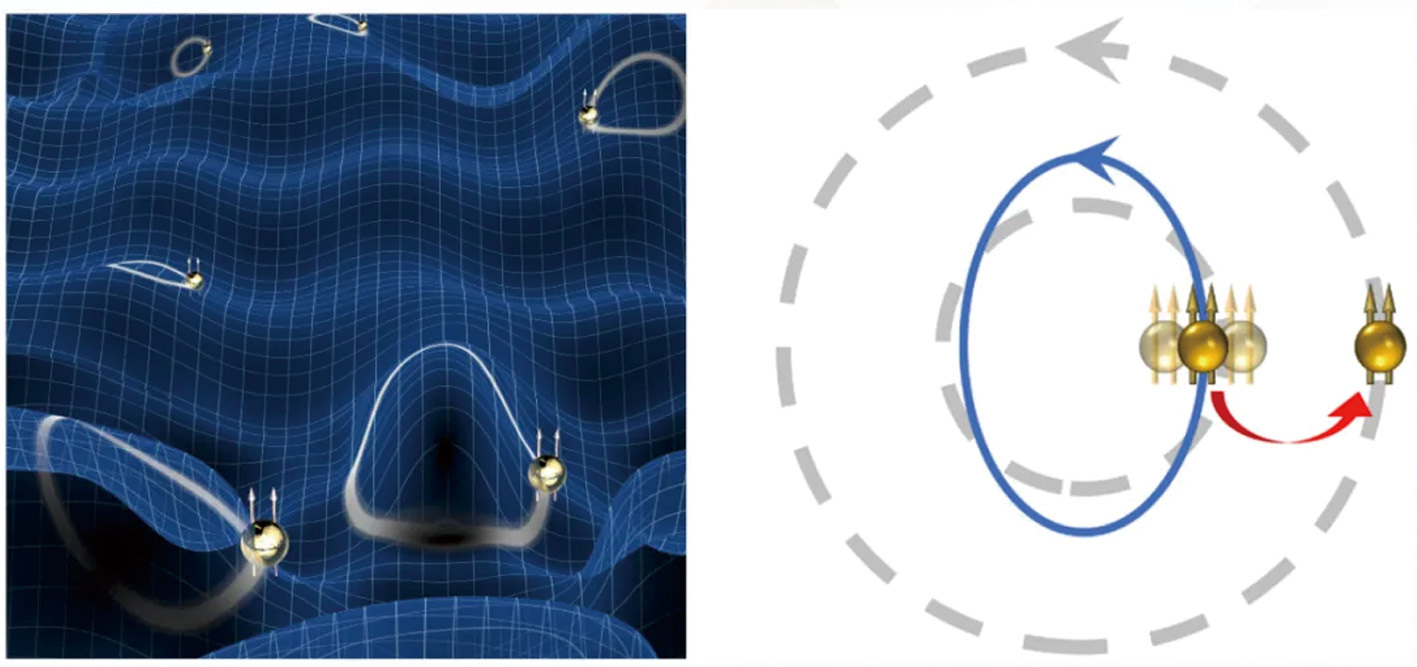
Figure 1: Graviton excitation in condensed matter. (left) The quantum metric describes the shape of the cyclotron-like orbitals of composite fermions. (Right) Orbital-shape deformation gives rise to the graviton mode that is the lowest-energy geometric excitation in the long-wavelength limit. (Image by Nanjing University)
The graviton mode is a quadrupole excitation and can be probed by inelastic light scattering through a two-photon process. To identify its spin quantum number, it was crucial to resolve the spins of the incident and scattered photons (Figure 2). However, such an experimental setup had long been unavailable.
Unlike the conventional inelastic (Raman) light scattering, this experiment poses extremely demanding requirements for the experimental setup. The setup needs to operate at extremely low temperatures (about 50 mK, or −273.1°C) and under strong magnetic fields (about 10 Tesla, more than 100,000 times the average magnetic field of the Earth), which can be achieved using dilution refrigerators equipped with superconducting magnets. However, the visible light used in the experiment and the thermal radiation entering through the optical windows of the refrigeration can easily raise the temperature above 100 mK. This makes it extremely challenging to maintain the experiment at such low temperatures. Moreover, the measurement is extremely sensitive to vibrations caused by the pulse-tube cooler of the dilution refrigerator.
On top of these difficulties, there is something even more challenging. The graviton energy is extremely low, reaching approximately 70 GHz at its lowest. It is therefore necessary to achieve resonant inelastic light scattering measurements in the microwave range, which is very difficult even at room temperature. Also, the experiment needs to use the circular polarization of light to measure the spin. All these requirements have made it a nearly impossible mission.
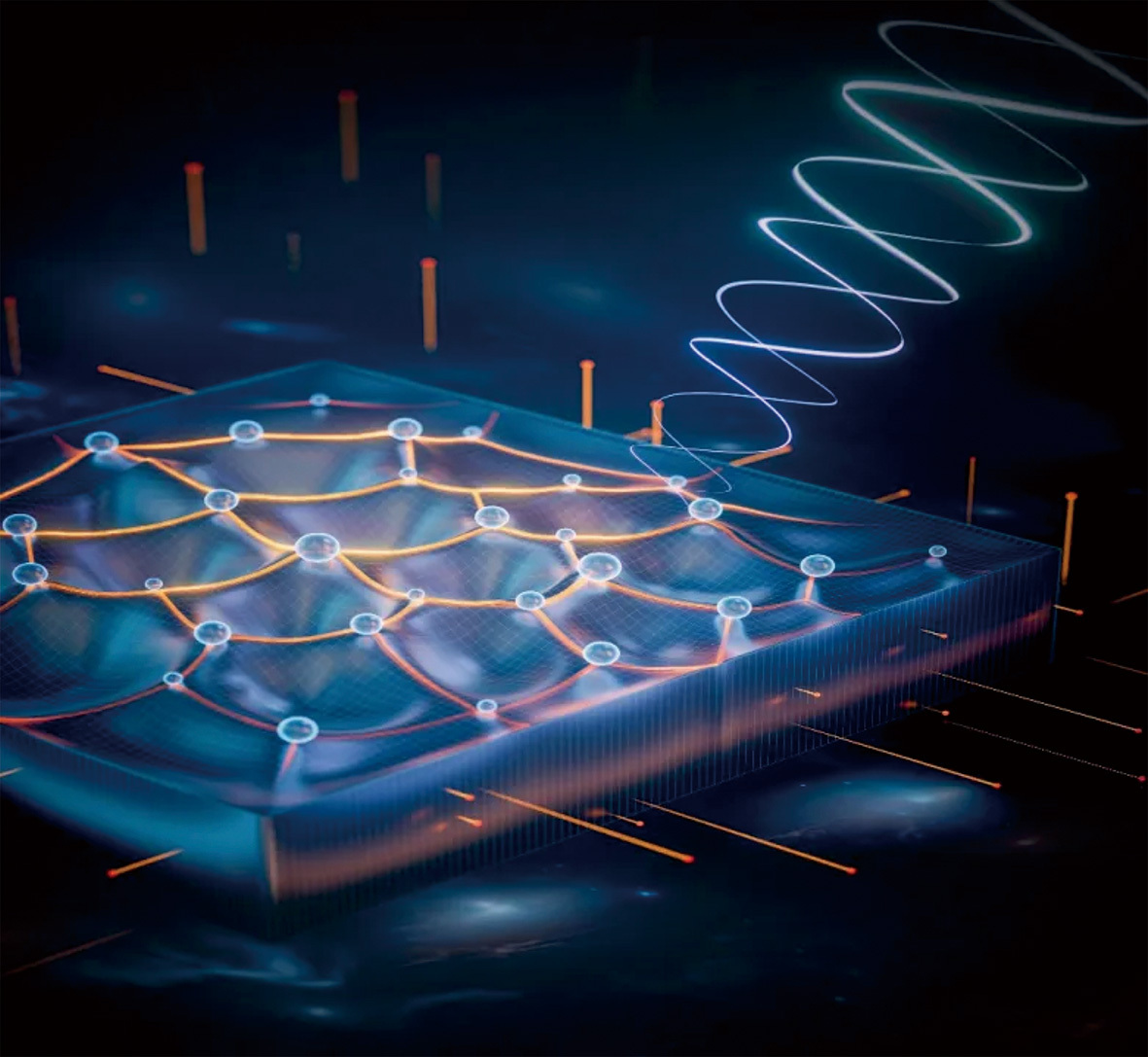
Figure 2: Measurement of the graviton excitation in a GaAs quantum well via circularly polarized light. (Image by Nanjing University)
Detection of Graviton Modes
Despite these challenges, Prof. DU and his team spent three years to develop a state-of-the-art resonance inelastic polarized light scattering system (Figure 3a) based on the He3-He4 dilution refrigeration technology at Nanjing University. This setup is two stories tall and can detect weak excitations with energies as low as 50 GHz at −273.1°C and determine their spins. The successful development of this facility laid an important foundation for the measurement of graviton modes.
With this tool, the experimental team observed fractional quantum Hall gravitons in a gallium arsenide quantum well, achieving a significant breakthrough. They observed the lowest-energy long-wavelength collective excitations through resonant inelastic light scattering; moreover, by measuring the spins of the incident and scattered light, they found that the excitation was indeed a chiral spin-2 excitation (Figure 3b). Furthermore, the sharp peaks of the excitations were consistent with the long-wave characteristics of the graviton mode (Figure 3c). Importantly, the measured energies in different fractional quantum Hall states were proportional to their fractional charges, which is the energy characteristics of graviton modes (Figure 3d).
Taken together, these results provided compelling experimental evidence for the existence of graviton modes in terms of spin, momentum and energy.
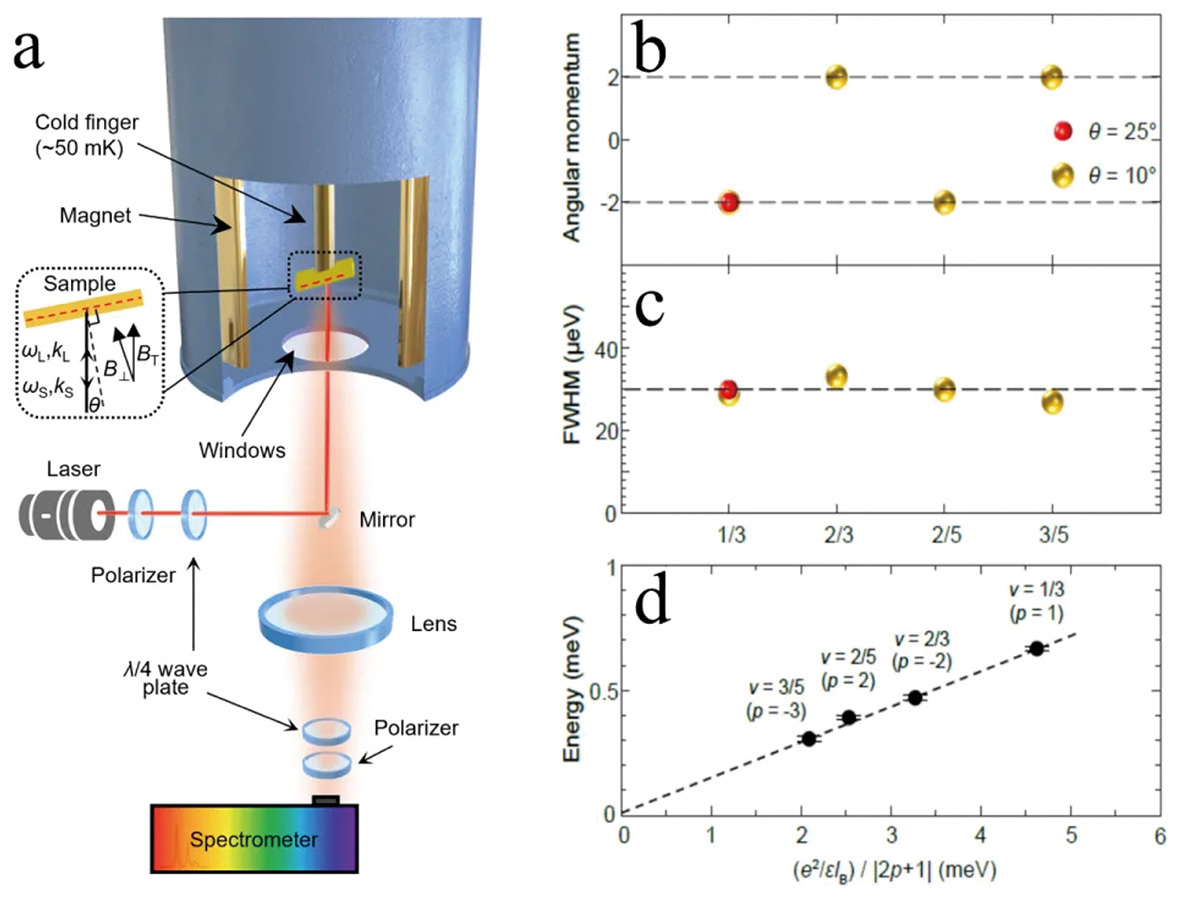
Figure 3: (a) Circularly polarized resonant inelastic light scattering measurement under low temperatures and strong magnetic fields. (b) Chiral spin-2 property of the observed gravitons. (c) The sharp peaks of the observed graviton modes reveal their long-wavelength characteristics. (d) The energy characteristics of the observed graviton modes. (Image by Nanjing University)
Prof. DU’s team successfully observed graviton modes in the fractional quantum Hall effect in a gallium arsenide quantum well using circularly polarized inelastic light scattering under extreme conditions. On March 28, 2024 (Beijing time), the team reported their findings in Nature in a paper titled “Evidence for chiral graviton modes in fractional quantum Hall liquids”.
Their exploration did not stop there. Instead, they embarked on a journey to generalize the graviton mode to bosonic system.
Endless Pursuit
The generalization of graviton modes to bosonic systems is of great significance for topological quantum computing, but previous experimental studies on the fractional quantum Hall effect had been limited to fermionic systems and had not been extended to bosonic systems. DU and his collaborators observed the topological edge state of the exciton insulator and revealed its Dirac point through one-dimensional Coulomb drag measurements in indium arsenic-gallium-antimony quantum wells; they found that the electron and hole densities at the charge neutral point were locally imbalanced. They further identified that it was a chiral excitonic edge state, while observing a finite-momentum exciton insulator in the bulk with imbalanced electron and hole densities. These results provide evidence for the fractional quantum Hall effect of excitons and reveal the fractional quantum Hall state for the first time in bosonic systems.
At the time of the Prize announcement, the origin of the observed graviton modes remained unclear; now, at the awarding ceremony, the team has more to evidence their excellence.
On June 22, Prof. DU and his team experimentally confirmed that the previously observed “graviton mode” originated from the geometric oscillations of “partons” in the associated electrons, and reported their new discovery in Nature Physics.
In the late 1960s, theoretical physicist Richard Feynman proposed that there are “partons” inside the proton to explain deep inelastic scattering experiments. The quark is a parton with the fractional charge. Later, theorists introduced the concept of “parton” into the fractional quantum Hall effect; according to this parton picture, in the strongly correlated electron systems under extremely low temperatures and strong magnetic fields, an electron can fractionalize into several emergent “partons”.
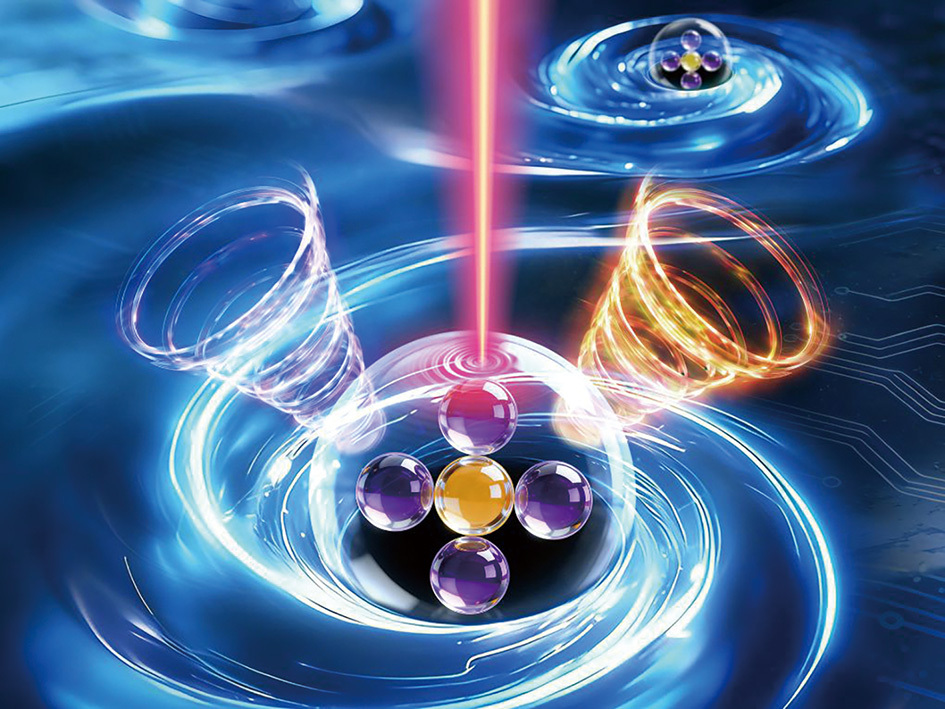
Figure 4: The inelastic light scattering experiment reveals two different “graviton modes.” The electron can be fractionalized into several emergent “partons”. DU’s team recently reveals that the gravitons they observed in 2024 had originated from geometric excitation of these parton quasiparticles. (Image by Nanjing University)
In the new research, DU’s team attempted to scatter photons from strongly correlated electrons under a stronger magnetic field. As a result, a new inelastic light scattering phenomenon was observed in a higher-energy region, revealing a high-energy graviton mode. By adjusting the experimental conditions, the team found that the graviton changed with the variation of the corresponding “parton”. For instance, if one “parton” became electrically neutral, the corresponding graviton would also disappear.
These results, DU’s team concluded, indicate that the “graviton” stems from the geometric oscillations of different “partons” in correlated electrons, and provide evidence for the existence of partons—quark-like quasiparticles in the fractional quantum Hall effect for the first time.
Far-reaching Influence
The detection of graviton modes was selected as one of the “Top 10 Scientific and Technological Advances in China in 2024” by the Chinese Academy of Sciences and the Chinese Academy of Engineering, with Prof. DU being the only team leader under the age of 40 at the time. The work was also selected as one of the “Top 10 Scientific Advances in China in 2024”.
The exploration of gravitons has long been one of the ultimate questions in physics. Whether gravitons exist is a fundamental issue of concern in contemporary physics and even the entire scientific field. The observation by DU’s team confirms the existence of a condensed-matter analogue of gravitons. Revealing the quantum principle of graviton physics in real systems, this significant discovery is also crucial for understanding correlated quantum physics and could help enable the future operation of topological quantum computers.
The experimental setup developed by his team has also won wide acclaims, being assessed as having “created extreme conditions involving single or combined physical parameters that reach or approach current technological limits”.
Reference
Du, L. et al., (2019) Observation of new plasmons in the fractional quantum Hall effect: Interplay of topological and nematic orders. Sci. Adv.5, eaav3407. https://doi.org/10.1126/sciadv.aav3407
Du, L., Zheng, J., Chou, YZ. et al. (2021) Coulomb drag in topological wires separated by an air gap. Nat Electron 4, 573–578. https://doi.org/10.1038/s41928-021-00603-y
Liang, J., Liu, Z., Yang, Z. et al. (2024) Evidence for chiral graviton modes in fractional quantum Hall liquids. Nature 628, 78–83. https://doi.org/10.1038/s41586-024-07201-w
Wang, R., Sedrakyan, T.A., Wang, B. et al. (2023) Excitonic topological order in imbalanced electron–hole bilayers. Nature 619, 57–62. https://doi.org/10.1038/s41586-023-06065-w
Yang, Z., Wang, Y., Lu, X. et al. (2026) Emergent partons in fractional quantum Hall systems. Nature Physics. https://doi.org/10.1038/s41567-026-03338-9