

The Tan Kah Kee Young Scientist Award in Chemistry goes to Prof. LIU Zhibo from Peking University, recognizing his pioneering contributions to radioactivity-driven chemistry. Operating at the intersection of life sciences and urgent clinical needs, his innovative covalent radiopharmaceutical technology shatters the historical bottleneck of traditional radiopharmaceuticals: the persistent trade-off between therapeutic efficacy and safety. Furthermore, LIU has leveraged the unique properties of radioactivity to uncover the anti-tumor immune activity of pyroptosis.
Targeted radionuclide therapy (TRT) initially emerged as a beacon of hope, using targeted ligands to deliver radionuclides directly to a tumor. Yet, this ingeniously designed “smart bomb” approach harbored a fatal flaw, which is the reversible binding of the ligand with target protein. Like a fleeting handshake, the radiopharmaceuticals approach, linger briefly, and then detach—frequently washing out from the target before the radiation can deliver its killing blow.
The first breakthrough hinges on a customized chemical modification applied to radiopharmaceuticals, creating what the researchers call covalent targeted radioligands (CTR). The core challenge in radiopharmaceutical design is a thorny balancing act. The drug should remain within the tumor with sufficient residence time for destructive efficacy, while simultaneously undergoing rapid clearance from healthy tissues to prevent severe systemic radiation toxicity. The researchers envisioned a targeted ligation strategy—a way to permanently weld the drug to the tumor protein without losing its initial targeting ability. To achieve this, they turned to a fascinating branch of click chemistry known as sulfur (VI) fluoride exchange (SuFEx), whose proximity-enabled reactivity endows these chemical warheads with high stability and bio-orthogonality before they reach their target.
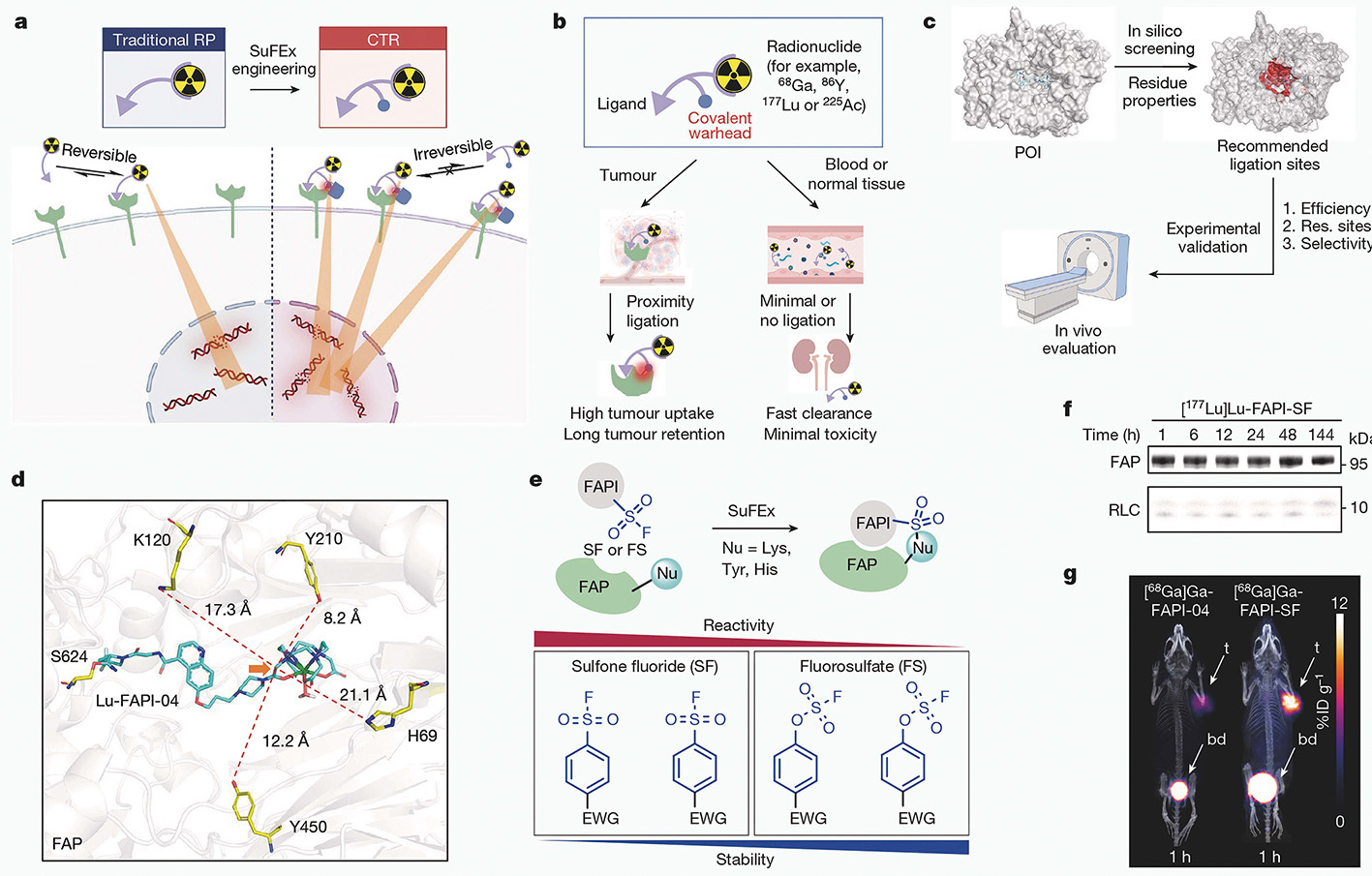
Computational design and experimental development of a Covalent Targeted Radiopharmaceutical (CTR) using SuFEx chemistry to irreversibly bind the FAP protein. Additionally, it demonstrates the successful proof of concept for this approach through in vitro binding assays and in vivo PET/CT imaging in tumor-bearing mice. (Graphic: Cui et al., 2024)
Imagine a key sliding into a lock. In traditional targeted therapy, the binding between radioligand and protein of interest (POI) is highly reversible—the key can easily detach from its target. By installing the SuFEx engineered “warhead” onto the radioligand, the researchers essentially rigged the key to irreversibly fuse with the lock the exact moment it turns. When the engineered radiopharmaceutical binds to a tumor-specific protein, such as fibroblast activation protein (FAP), the physical proximity of the molecules triggers a chemical reaction. It forms an irreversible covalent bond with the tyrosine residues inside the protein’s binding pocket. The results observed in the laboratory were extraordinary. The engineered drug triggered over 80% covalent binding to the target protein with almost zero dissociation for six consecutive days, which is perfect given that the half-lives of most therapeutic radionuclides are three to ten days. In vivo evaluation revealed that this engineered molecule achieved a remarkable 257% increase in tumor uptake compared to the original drug, extending intratumoral retention by 13-fold.
Naturally, the concept of a radiopharmaceutical permanently attaching to proteins raises significant public safety concerns. If a radioactive compound irreversibly bound to healthy tissues or vital proteins in the bloodstream, the resulting systemic toxicity would be catastrophic. The researchers anticipated this exact threat. They carefully screened various chemical warheads, ultimately selecting a particular fluorosulfate group that possesses relatively low baseline reactivity. This specific “warhead” is remarkably stable in the bloodstream, completely ignoring abundant proteins like human serum albumin. It acts as a bio-orthogonal sleeper agent—it only awakens and reacts when it is perfectly cradled inside the specific microenvironment of the cancer protein’s active site. Unbound molecules are rapidly and safely excreted through the kidneys, leaving healthy organs unharmed.
This meticulous design has already shown immense potential in human patients. In a pilot clinical trial involving patients with medullary thyroid carcinoma—a notoriously difficult-to-image neuroendocrine tumor—the covalent radioligand successfully identified numerous hidden metastatic lesions that were completely missed by standard imaging methods. These molecular handcuffs, equipped with highly radioactive β-emitting Lutetium-177 (177Lu) or α-emitting Actinium-225 (225Ac) isotopes, almost completely suppressed tumor growth in mouse models, offering a tantalizing glimpse into the future of cancer treatment in humans.
While CTR technology anchors radiation to the tumor, Prof. LIU’s team envisioned a broader role for radioactivity: serving as a chemical detonator to ignite a systemic immune response. This second breakthrough leverages “pyroptosis”—a highly inflammatory form of programmed cell death whose name evocatively means “fiery death”. Unlike apoptosis, which is a quiet and orderly cellular suicide, pyroptosis causes the cell to swell, burst, and unleash a cascade of inflammatory signals into the microenvironment.
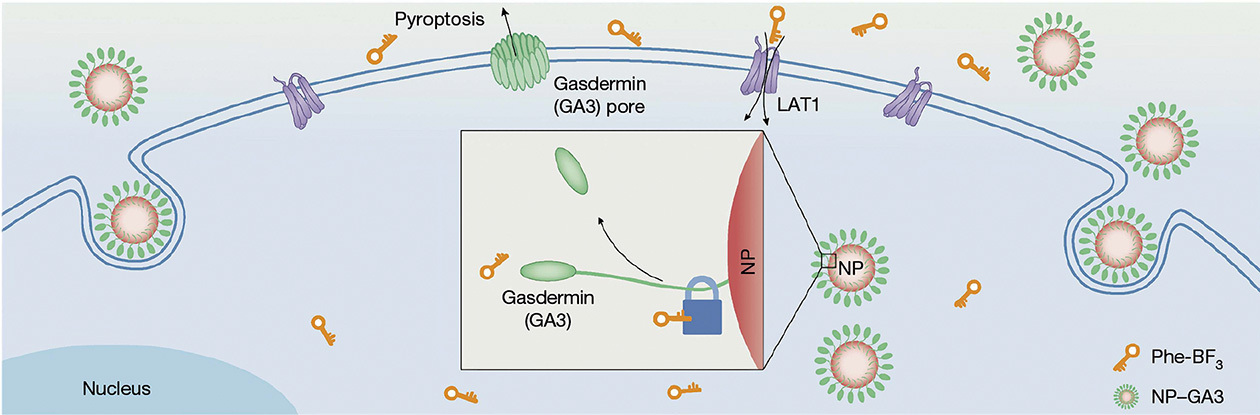
Phe-BF3 desilylation releases gasdermin from NP–GSDMA3 conjugates to form the pores within the cellular membrane and induce pyroptosis. (Graphic: Wang et al., 2020)
To achieve this goal, a bioorthogonal cleavage system was designed utilizing phenylalanine trifluoroborate (Phe-BF3), a clinically validated safe PET imaging probe, to act as molecular scissors for efficient desilylation. The researchers encapsulated gasdermin—a potent pore forming protein—into nanoparticles, keeping it in an inactive state via a silyl ether linkage. Upon systemic administration in tumor-bearing mice, these nanoparticles accumulated within the tumors. Subsequently, the researchers injected the Phe-BF3 probe, which infiltrated the cancer cells, chemically shearing the silyl ether bond via a rapid desilylation, and thereby unleashing the therapeutic gasdermin.
Once released, the gasdermin protein punched microscopic holes in the cancer cells’ membranes, inducing violent pyroptosis. The elegance of this approach lies in its astonishing efficiency. The researchers discovered that total tumor destruction was unnecessary. Detonating less than 15% of the tumor cells was sufficient to eradicate massive, aggressive mammary tumor grafts in mice. The mechanism behind this efficacy is immunological: The fiery death of that small cell fraction acted as a blaring biological siren, alerting the host’s immune system to the malignancy. As a result, cytotoxic T-cells flooded the tumor microenvironment, hunting down and slaughtering the remaining cancer cells. Furthermore, this pyroptosis-induced inflammation possessed the remarkable ability to turn immunologically “cold” tumors into “hot” ones, rendering them highly susceptible to immune checkpoint blockade, such as anti-PD1 therapies.
By fusing the destructive power of radioactivity with the pinpoint precision of covalent chemistry, researchers are rewriting the paradigm of modern oncology. Whether by snapping unbreakable molecular handcuffs onto elusive cancer proteins or detonating targeted cellular explosions to awaken a dormant immune system, these dual-action innovations usher in a great leap in the fight against cancer.
Reference
Cui, X. Y., Li, Z., Kong, Z., Liu, Y., Meng, H., Wen, Z., . . . Liu, Z. (2024). Covalent targeted radioligands potentiate radionuclide therapy. Nature, 630(8015), 206–213. doi: 10.1038/s41586-024-07461-6
Wang, Q., Wang, Y., Ding, J., Wang, C., Zhou, X., Gao, W., . . . Liu, Z. (2020). A bioorthogonal system reveals antitumour immune function of pyroptosis. Nature, 579(7799), 421–426. doi: 10.1038/s41586-020-2079-1