

By YAN Fusheng
Two genes vanished from a Salmonella lineage, and it took over the world. Genomic surveillance across 44,597 genomes, plus competition experiments in mice, now explain how an ordinary stomach bug turned into one of the most common causes of foodborne outbreaks—and why losing the right genes in the right order can matter more than gaining new ones.
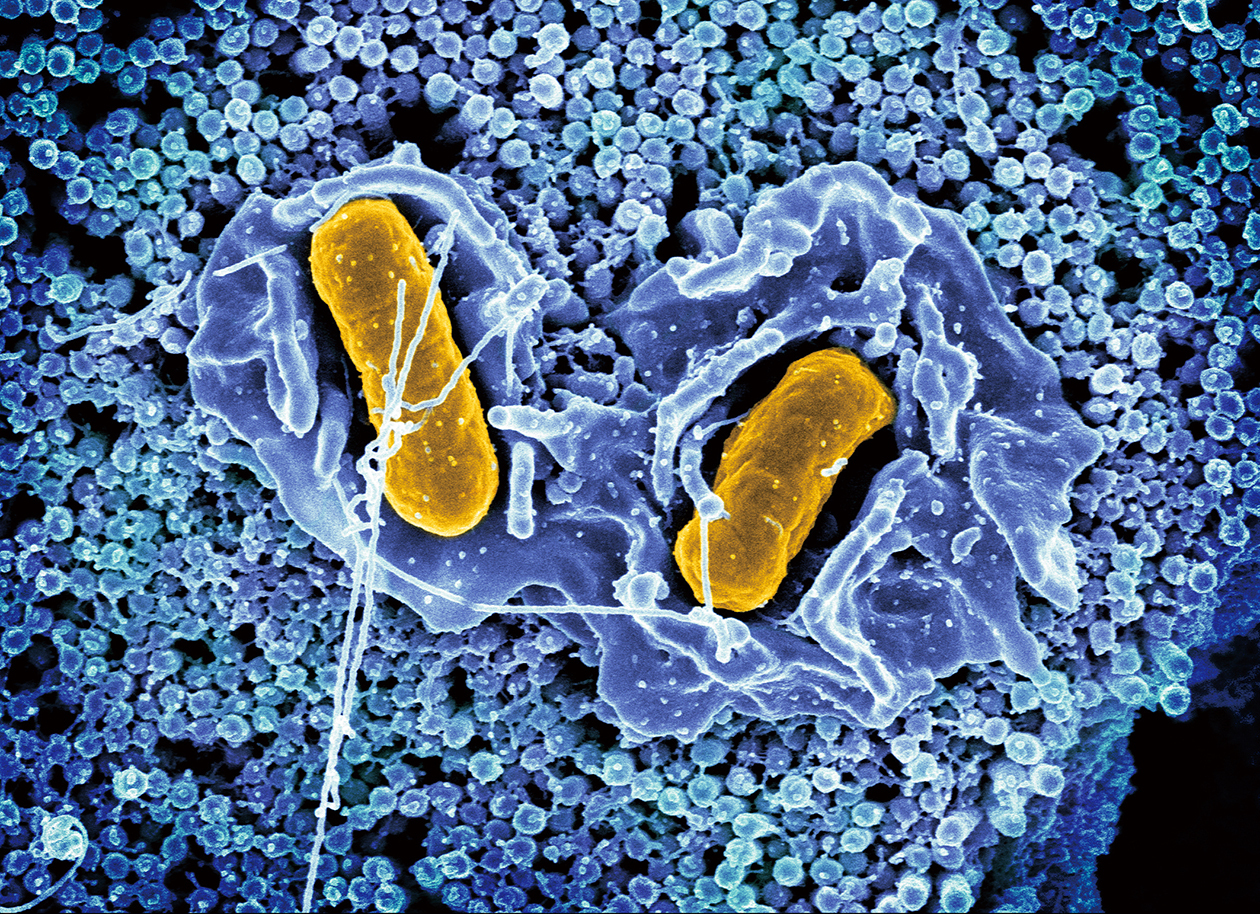
Salmonella Typhimurium is a notorious foodborne stomach bug responsible for widespread diarrheal outbreaks. Counterintuitively, one particular lineage of this pathogen took over the globe by quietly discarding two genes in sequence. (Graphic: NIAID, CC BY 2.0 via Wikimedia Commons)
In the evolutionary playbook of bacterial pathogens, success usually comes from gaining something, such as an antibiotic-resistance gene, a new toxin, or a metabolic shortcut. The rise of monophasic Salmonella Typhimurium (mSTM) ST34, however, flips that logic. This lineage became one of the world’s dominant causes of foodborne bacterial illness not by acquiring new weapons, but by quietly discarding two of them.
A team led by Prof. YUE Min at the Hangzhou Institute for Advanced Study (HIAS), University of Chinese Academy of Sciences (UCAS), reconstructed this disappearance act from 44,597 Salmonella Typhimurium genomes and then replayed it in living mice. Their conclusion, published in Nature Microbiology, is that two sequential gene losses, including first a broken DNA-repair polymerase, then a flagellar gene, converted an ordinary gut pathogen into a globally successful clone.
The scale of that success is stark. According to global genomic surveillance data, the monophasic ST34 variant (mSTM ST34) surged from 1.1% of typed isolates in 2001–2005 to 39.7% between January 2016 and February 2023, progressively displacing STM ST19, the clone that had dominated in the 1990s. From 2008 to 2022, mSTM ST34 became a leading cause of foodborne outbreaks worldwide. Its host range spans food animals, yet the majority of sequenced isolates come from people—a signature of a zoonotic lineage moving efficiently from farm to fork to patients.
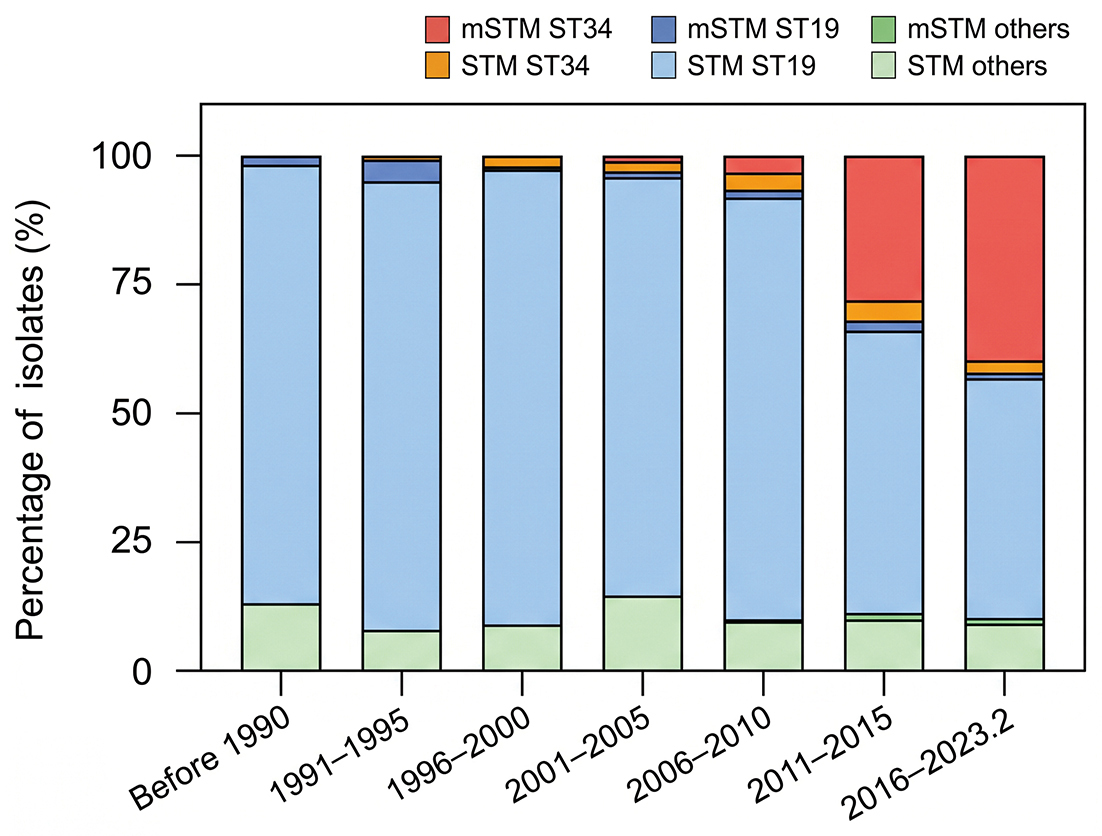
The rise of a pandemic clone. Genomic surveillance shows mSTM ST34 expanding from 1.1% of isolates in 2001–2005 to 39.7% between January 2016 and February 2023, while the once-dominant STM ST19 declines. (Graphic: Wu et al., 2026)
Pinpointing the First Gene Loss (dinB)
To find the genetic cause of this advantage, the researchers scanned the genomes for mutations specific to the ST34 lineage. They discovered a single-base deletion (a frameshift mutation) in the dinB gene that was present in nearly 100% of mSTM ST34 isolates. Normally, dinB encodes a DNA polymerase enzyme responsible for repairing DNA damage. The researchers confirmed through functional assays and mass spectrometry that this mutation results in an insufficient amount of functional protein, leaving the bacteria highly vulnerable to DNA-damaging agents.
Rewiring the Flagellar Switch
To understand why a broken DNA repair enzyme would lead to higher infectivity, the team conducted a Transposon Insertion Sequencing (Tn-seq). They created massive libraries of mutated bacteria and fed them to mice to see which genes were needed to colonize the gut.
In a normal wild-type Salmonella, two genes responsible for building the bacteria’s tail-like appendages (fliC and fljB) are essential for gut infection. In the dinB mutant, the rules changed: both fliC and fljB became dispensable. The broken dinB gene had fundamentally rewired the pathogen’s genetic requirements and shifted its protein expression heavily toward fliC.
Testing Fitness and the Second Gene Loss (fljB)
Normal Salmonella is “biphasic”—it toggles back and forth between using the fliC and fljB flagellar genes. However, the mSTM ST34 clone is “monophasic;” it completely lacks the fljB gene and its regulatory switches, leaving fliC permanently locked in the “on” position.
The researchers ran mixed-infection competition assays in mice to test these exact genetic combinations. They found that the dinB mutation alone gave the bacteria a colonizing advantage over the wild type. They also found that deleting fljB in a bacterium that already had a broken dinB gene made it colonize even more effectively.
In actual global genomes, the space left behind by the deleted fljB gene is systematically replaced by integrated cassettes conferring resistance to heavy metals and antimicrobials (like tetracycline and ampicillin). This provides a massive fitness benefit in livestock and agricultural environments where these agents are widely used, driving onward zoonotic transmission. Indeed, such a competitive advantage of monophasic pandemic clones over classic biphasic clones within the swine gut has been reported by independent investigators from the US and EU.
Order Matters: First dinB, Then fljB
Finally, the team wanted to know if the order of these gene losses mattered. They constructed a time-scaled evolutionary family tree of 1,091 isolates and built a spatial mathematical model. The modeling proved that the fljB mutant on its own gained no competitive advantage over the wild type; the dinB frameshift mutation had to come first. Consistent with that dependency, the global collection contained neither single fljB mutants nor mSTM ST34 isolates carrying a wild-type dinB. The evolutionary model that emerges has three steps: the ancestral ST34 lineage acquired the frameshift dinB; insertion sequences carrying resistance genes then disrupted fljB while fliC was retained, conferring an advantage over STM ST19; and the resulting mSTM ST34 clone, broken polymerase plus missing flagellin gene, spread across the world.
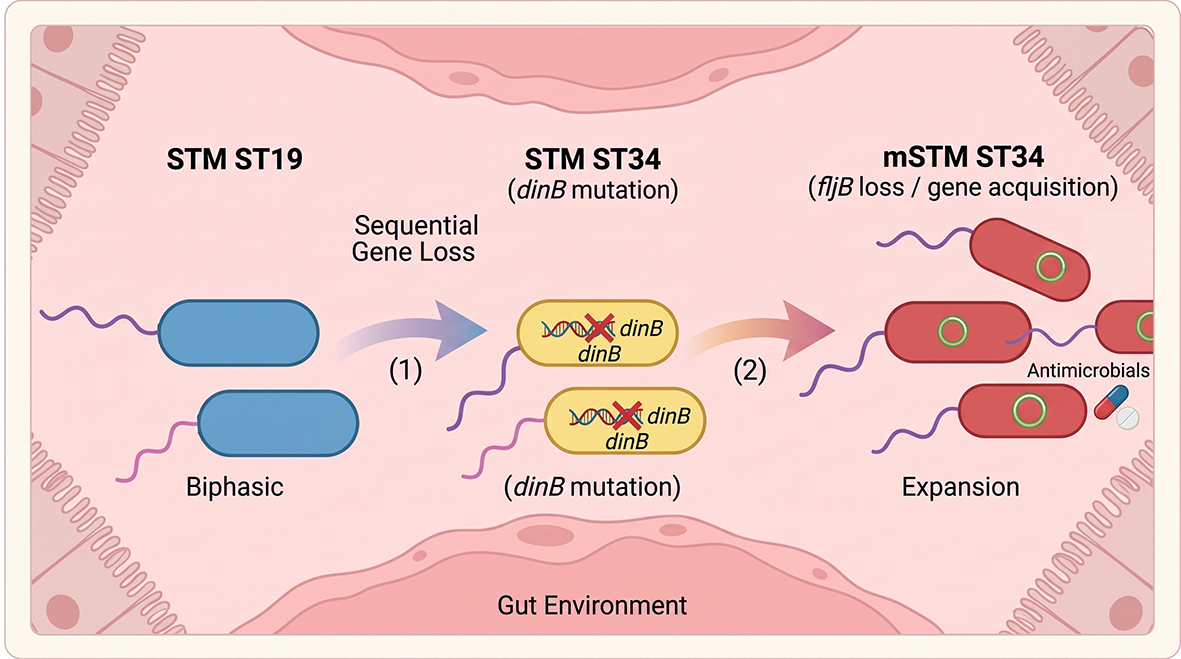
A three-step path to dominance. The ancestral ST34 lineage first acquires a frameshift in dinB; loss of fljB with retention of fliC then confers an advantage over STM ST19 due to the integration of resistance genes; the resulting mSTM ST34 clone expands into a globally dominant population. (Graphic: YAN Fusheng)
Implications for Food Safety and Pandemic Forecasting
The variant mSTM ST34 is a gut-adapted clone. Its invasiveness index, a measure of how readily a strain crosses the intestinal barrier, sits well below that of the invasive STM ST313, matching the clinical picture of gastrointestinal illness rather than systemic disease. But high prevalence and a broad host range among food animals mean that a primarily diarrhoeal pathogen can generate enormous public-health and economic costs through the food chain.
The study carries a broader message for how we think about emerging pathogens. Gene loss is increasingly recognized as a route to adaptation, and this work shows it operates as a stepwise, order-dependent process that can be reconstructed from genomes and tested in animals. That kind of framework is what surveillance programs need if the goal is to move from describing outbreaks to anticipating which variants might pose the next pandemic threat.
Yet, translating this framework into real-world surveillance comes with two notable constraints. The evolutionary reconstruction rests on genomic data from public repositories, which vary in sampling density across regions and years; and the fitness advantage was measured in murine competition assays, the standard model for Salmonella gut colonization. Turning this mechanism into a predictive tool will require prospective surveillance linking genotypes to human case data. Still, the central finding is unusually clear: for at least one globally successful pathogen, the winning move was not to gain a gene, but to lose the right two in the right order.
Reference
Wu, X., Wang, T., Jia, C., Zhou, H., Li, Y., Baker, S., & Yue, M. (2026). Sequential gene loss promotes expansion of monophasic Salmonella Typhimurium ST34. Nature Microbiology. doi: 10.1038/s41564-026-02483-4