

By YAN Fusheng
Traditional air samplers need power, pumps, and trained operators. Inspired by how a butterfly drinks through a bursting liquid film, researchers at the Technical Institute of Physics and Chemistry (TIPC) of the Chinese Academy of Sciences have built a pump-free, power-free device that can collect materials from the air at a cost of just $0.12 per unit.
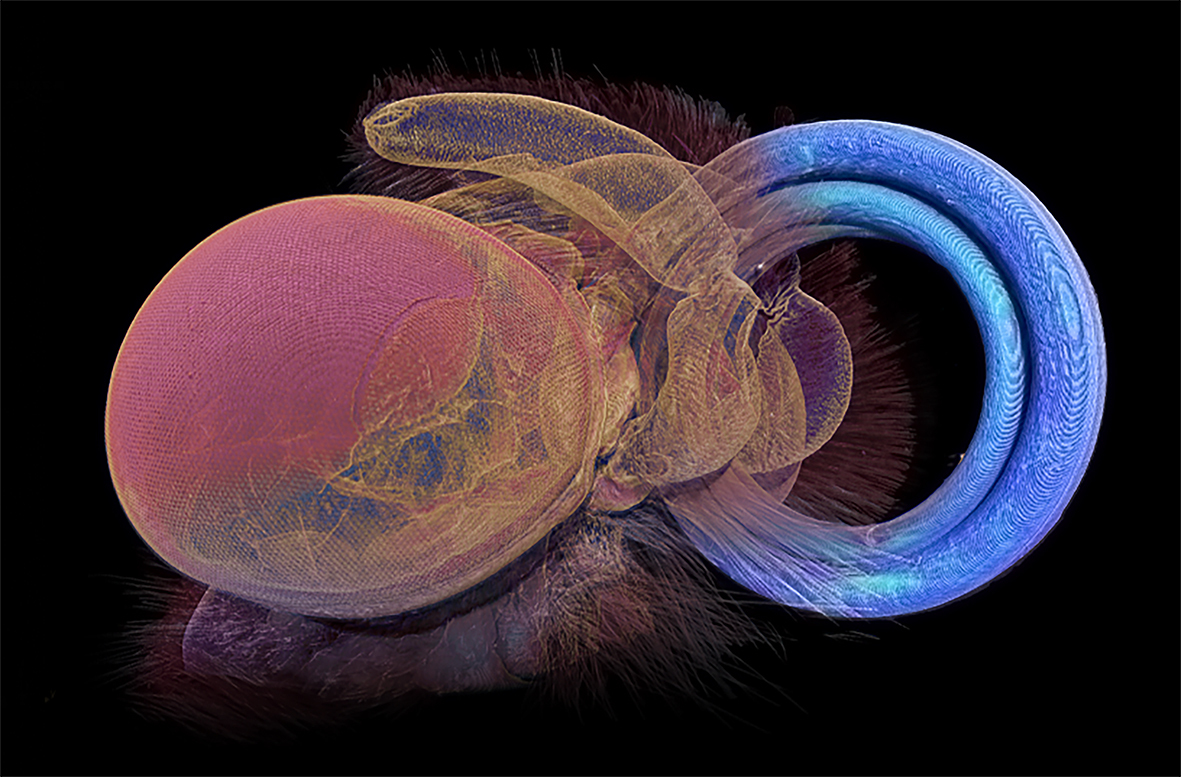
A paper kite butterfly drinks from a bursting film across a ring formed by its curled proboscis, aside from directly sucking nectar up through the inner channel. (Graphic: TIPC)
Most butterflies drink in the way you would expect: they unfurl a long straw-like proboscis and use their muscles to pump nectar up through it. One paper kite butterfly, known to scientists as Idea leuconoe, does something stranger. After feeding, it coils its proboscis into a ring and spins a thin film of liquid across the middle of that ring. Before long the film gets thinner and thinner, and at a critical moment it suddenly bursts. The burst is not a failure. It is the whole point.
Why would a butterfly with a perfectly good mouthpart go to this trouble? The answer is energy. When the film ruptures, the energy stored at the liquid surface is released all at once, and that pulse draws the entire film’s worth of nectar into and along the canal—quickly, completely, and almost for free. The butterfly makes a little effort to thin the film, then lets a burst of surface energy do the heavy lifting. In effect, it turns a stored bit of interfacial energy into a one-shot pump.
From a Butterfly’s Drink to a Device
Using X-ray imaging on living insects, Dr. DONG Zhichao and his colleagues at the Technical Institute of Physics and Chemistry (TIPC) of the Chinese Academy of Sciences watched this break-and-sip mechanism from the inside. They then built a simplified replica of the coiled proboscis: a ring-shaped holder carries the liquid film (mimicking the coiled tube), a circular canal connects to a capillary tube (mimicking the food canal), and a narrow slit links the two (mimicking the proboscis’s microslits). The inner pathway is hydrophilic so liquid moves freely, while the outer wall is hydrophobic to prevent any leakage. The resulting device, named FACE (film-rupture actuated capillary enrichment) sampler, is entirely 3D-printed from low-cost polymer at roughly $0.12 per disposable unit, as they detailed in PNAS on August 13, 2026.
Sampling with FACE is simple. You dip the ring into a watery solution, pull it out to stretch a thin film across the opening, and hold the device where the air is. The film works like a sticky net, catching whatever touches it—soluble gases, tiny liquid droplets, or small wettable particles alike. When you are done, you press a test strip against the outlet and the film bursts, driving the collected liquid straight onto the strip. No pump, no battery, no external power. The entire collection, recovery, and readout chain happens in one device.
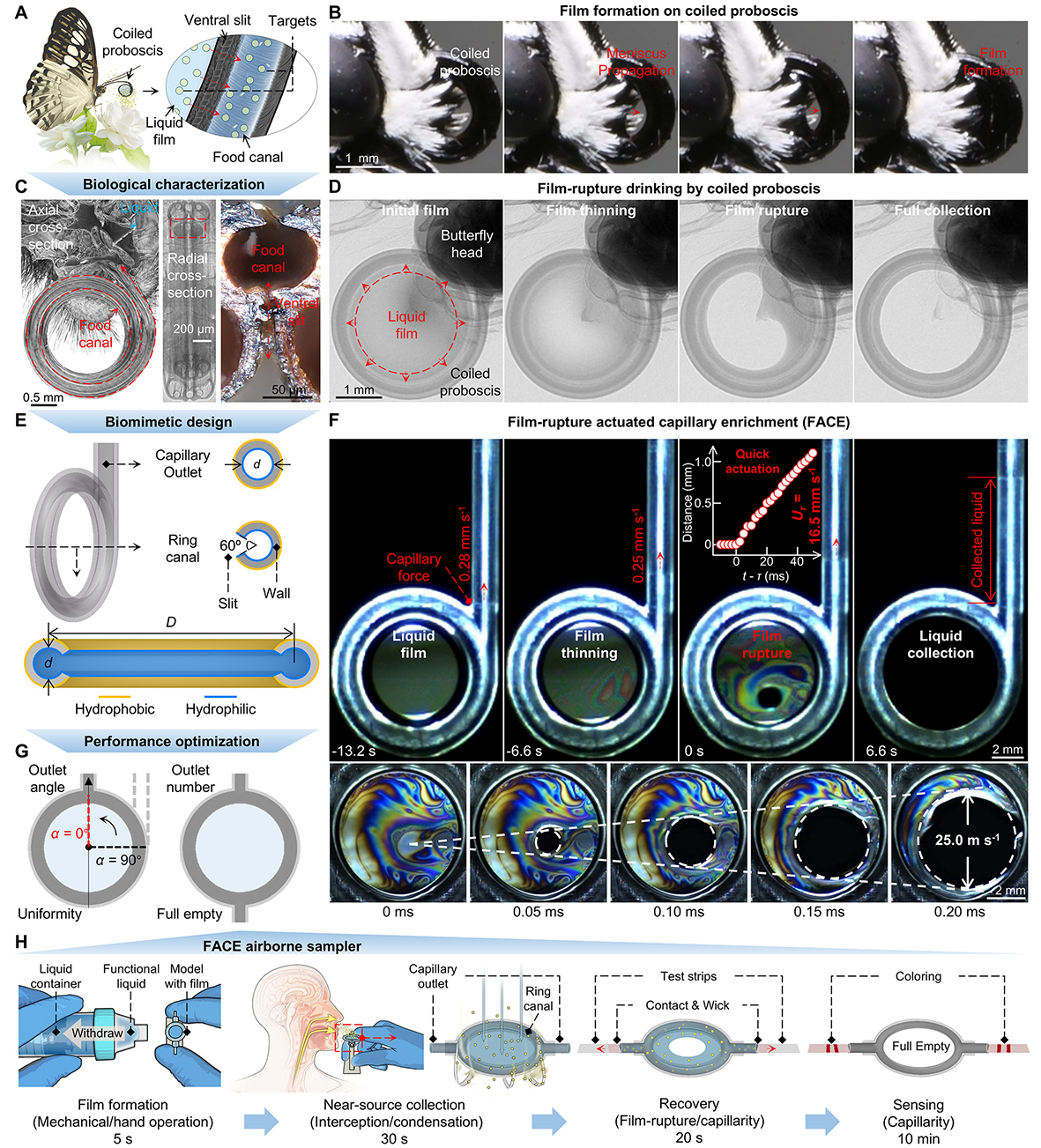
Nature’s inspiration: an alternative way of butterflies to drink nectar (A–D), and a new pump-free airborne sampling technology (E–H). (Graphic: TIPC)
The Physics behind the Pop
The mechanism hinges on surface energy. When the film bursts, the tension at its surface sends a rim sweeping inward at roughly 25 meters per second, a process described by the Taylor–Culick relation. The event is over in about 0.35 milliseconds. In so short a time gravity pulls the liquid downward by less than a micrometer, so almost none of it drips away; it all gets collected. When the retracting rim meets the liquid already sitting in the ring channel, it creates a transient pressure pulse that forces liquid into the capillary tube, accelerating the meniscus to about 16 millimeters per second within 50 milliseconds. The team then optimized the geometry—using a smooth, Tesla-inspired turn and a double outlet—so that the ring empties almost completely, leaving only about 0.8% residue. It triggered in under half a millisecond, moving liquid faster than 50 millimeters per second. Spontaneous film rupture, long regarded as too quick and too random to control, becomes a deliberate and repeatable way to move a small load of liquid.
One Device, Many Jobs
The device was tested in several very different settings. In a sealed chamber it sampled ammonia gas and, with a pH indicator, changed color on the spot; paired with ion chromatography it produced a clean calibration across three concentrations and measured 37.3 milligrams per cubic meter of ammonia at a public restroom drain. The film also held up in wind up to 4.5 meters per second, so the team mounted the sampler on a plant-protection drone. After a pesticide spray, the drone flew over farmland and the sampler caught airborne chlorpyrifos, pressing a test strip that changed color with the residue, while parallel HPLC analysis was used to estimate how long a worker should wait before re-entering the field.
Better Than a Pump, Close to the Breath
The most striking application is respiratory screening. Exhaled breath contains viruses and other markers, and it is at its most concentrated right at the mouth and nose, before it disperses. The team designed the sampler to sit near that source. In a proof-of-concept test they made mists containing the SARS-CoV-2 nucleocapsid protein, let the sampler collect for 20 seconds, and fed the liquid to a commercial antigen test strip. The strip showed a visible positive line at a protein concentration of 10-12 moles per liter. A conventional pump-suction impinger needed a 100-fold higher concentration to produce the same result. Across collection, recovery, and dilution, the FACE sampler recovered nearly 100% of what it caught—with a dilution ratio of 1.14—against 21.97 for the impinger, which lost material to its tubing and walls. The whole unit, at about $0.12 and with no power source, is designed to be disposable once used.
Where It Can Go—and Where It Cannot
The design has a clear strength and a clear limit. Because the film catches what flows to it rather than drawing in a fixed volume of air, the sampler works best close to the source; that suits on-the-spot screening rather than wide-area ambient monitoring. The film is also sensitive to heat and dryness, because evaporation shortens its life, and a water-based film cannot trap insoluble gases or large, water-repellent particles. The authors are open about these bounds and suggest additive formulations for future work. The broader point they make is that film rupture, once dismissed as too spontaneous to be useful, can be a controlled engine for moving liquids—an idea that may reach beyond airborne sampling. In the end, a butterfly’s small drink has become a new way to test the air a person breathes.
Reference
Zhang, C., Liu, S., Shen, T., Yu, C., Chu, F., Jiang, L., & Dong, Z. (2026) Film-rupture actuated pump-free capillary enrichment for near-source airborne sampling. Proceedings of the National Academy of Sciences USA 123(33), e2615727123. doi:10.1073/pnas.2615727123