

Mitochondrial diseases—caused by defects in the cell’s energy-generating machinery—have long resisted effective treatment. Researchers from LIU Xinguo’s group at the Guangzhou Institutes of Biomedicine and Health (GIBH), Chinese Academy of Sciences, have now developed a method to deliver healthy mitochondria directly into diseased cells.
As published in Cell (March 2026, doi: 10.1016/j.cell.2026.02.023), the team encapsulated donor mitochondria inside vesicles made from red blood cell membranes, producing microscopic “mitochondrial capsules” roughly one micrometer across. These capsules protect their cargo during delivery and achieve around 80% transplantation efficiency in cultured cells. Once inside, the donor mitochondria fuse with the recipient cell’s own mitochondrial network and sustain long-term function.
Testing in cells carrying mtDNA deletions or point mutations, the team showed that the transplanted mitochondria compensated for the genetic defects, restoring normal energy production. They then validated this in animal models: in mice with Leigh syndrome, a severe mitochondrial disorder, capsule treatment improved motor performance and extended survival; in a mouse model of mitochondrial DNA depletion syndrome, it restored mtDNA levels and reversed liver damage; and in a pharmacological model of Parkinson’s disease, it rescued neurons, improved motor skills, and recovered mitochondrial function in affected brain regions. The authors proposed this as a broader “organelle therapy” strategy—one that could eventually extend to other degenerative diseases rooted in cellular energy failure.
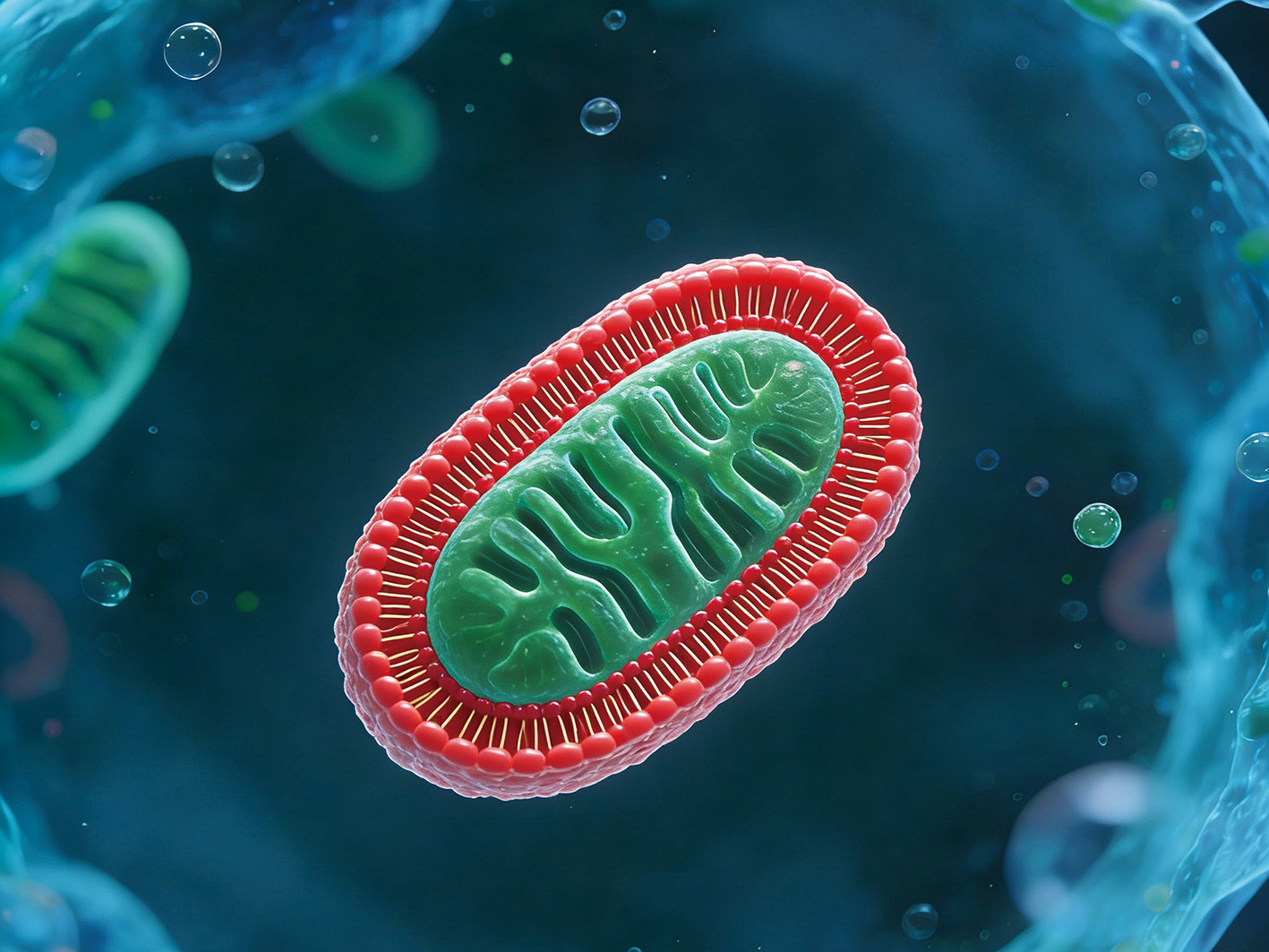
Encapsulated mitochondria as a therapeutic vehicle. A donor mitochondrion (green) is wrapped in a red blood cell membrane-derived vesicle (red), shielding it for delivery into cells with mitochondrial dysfunction—an approach shown to rescue disease models of Leigh syndrome, mtDNA depletion syndrome, and Parkinson’s disease. (Graphic: LIU Xinguo’s group)