

Soil is far more than dirt—it is a living, porous system threaded with microscopic channels that draw rainwater deep underground, where plant roots can reach it. Researchers at the Institute of Geology and Geophysics of the Chinese Academy of Sciences (IGGCAS), along with their international collaborators, have now shown, in striking detail, how common farming practices quietly destroy this natural plumbing. The findings were published in Science (doi: 10.1126/science.aec0970) on March 19.
To observe what happens beneath the surface without disturbing the land, the team repurposed standard fiber-optic cables—the same kind used in broadband internet networks—into a large sensor array buried across an experimental farm at Harper Adams University in the United Kingdom. By detecting the faint vibrations produced by water moving through soil, the array tracked subsurface water flow minute by minute. In heavily cultivated fields, rainfall pooled near the surface rather than infiltrating downward. Shallow water evaporates quickly, leaving deeper soil layers dry and inaccessible to crops. In undisturbed soil, water moved efficiently into deeper layers, where it remained available during dry spells.
To explain these differences, the team developed a model built around the “ink-bottle effect”—water enters a soil pore easily but escapes with difficulty, held back by capillary forces that shift depending on whether the soil is wetting or drying. Repeated plowing and heavy machinery don’t merely compact soil particles; they sever the mechanical bonds that keep these capillary networks intact. Without them, soil loses its ability to buffer crops against both flooding and drought—a vulnerability that will only deepen as extreme weather becomes more frequent.
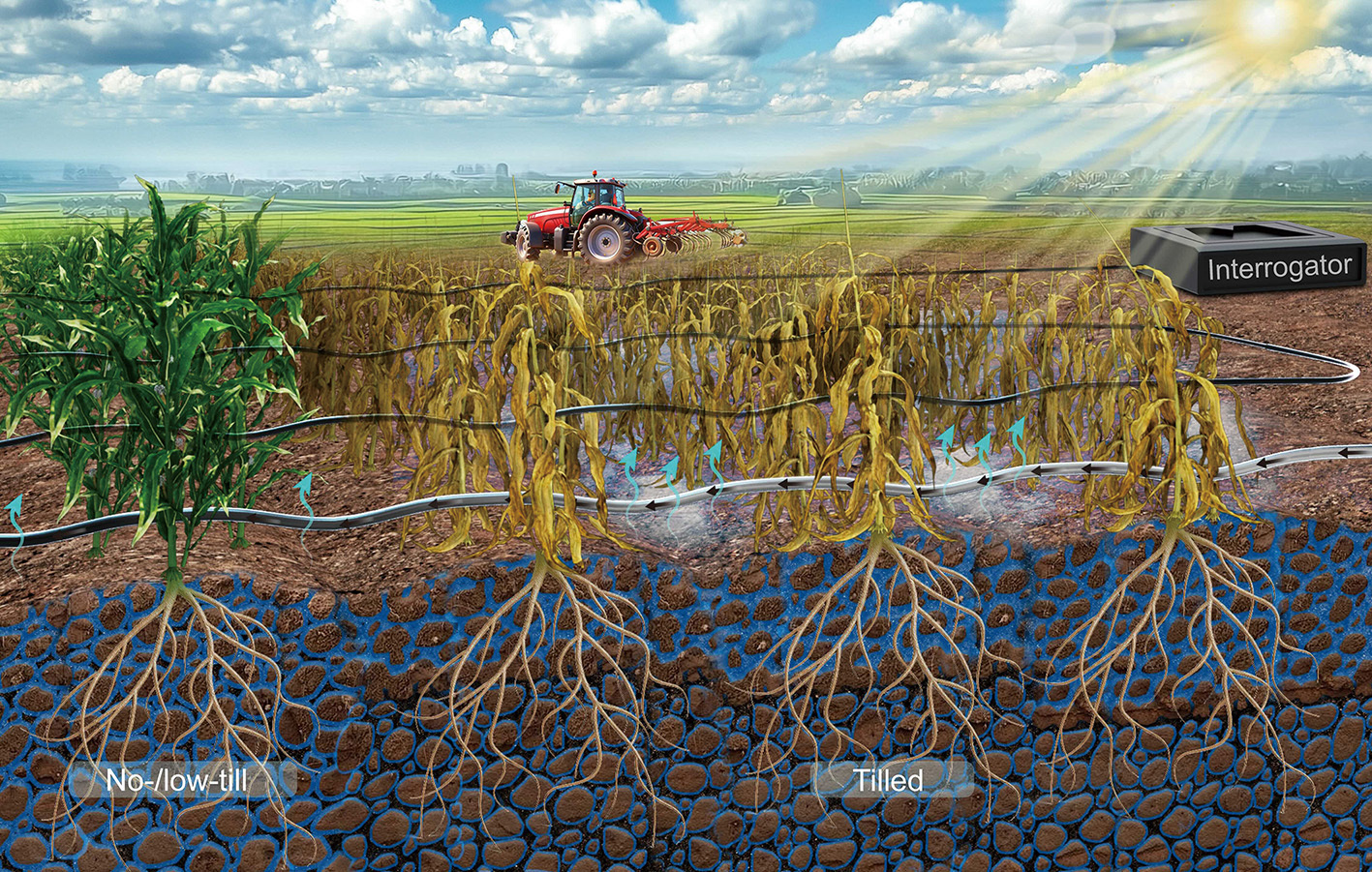
Impact of farming practices on soil porous structure and hydrological process revealed by distributed acoustic sensing. (Image by IGGCAS)