

A research team working on EAST, the Experimental Advanced Superconducting Tokamak hosted in the Institute of Plasma Physics (ASIPP) under the Hefei Institutes of Physical Science, Chinese Academy of Sciences, has broken through an empirical limit on plasma density in their experiment. Exactly on the first day of the year 2026, the team reported in Science Advances (https://doi.org/10.1126/sciadv.adz3040) their progress, experimentally verifying and theoretically developing a physics model predicting the “density-free” regime.
To trigger a controlled, sustainable nuclear fusion in a tokamak, the particles in the ignition beam must reach a certain energy to overcome the mutual repulsion between the protons. For a deuterium-tritium fusion, the optimal energy for each particle in the star-up plasma is around 13 keV. This requires a plasma temperature as high as 150 million Kevin. Electron density of the start-up plasma is crucial for achieving the required temperature, however, nuclear fusion experiments have been troubled with an empirical threshold called Greenwald density limit (GDL). When the density reaches this threshold, the plasma generally disrupts, with particles escaping from the confinement of the magnetic fields.
After long experimental explorations, the international plasma physic community arrived at the understanding that the disruptive physical process occurs on the edge of the plasma; but the underlying mechanism has remained elusive.
A model, the plasma–wall self-organization (PWSO) theory first proposed by D.F. Escande et al. from the French National Center for Scientific Research and Aix-Marseille University, shed some new light on this mechanism. The model predicts that radiation from impurity in the plasma could be the primary cause of the power imbalance; and largely this radiation is influenced by the interactions between the plasma and the device wall. Therefore, by reducing the impurity — for example the physical sputtering from the wall, a delicate balance could be maintained to access a density-free regime.
Some key aspects of this model were later experimentally validated. For example, measures to reduce the impurity, including raising the initial heating power or the prefilled gas pressure, were demonstrated efficient in enhancing the achievable density limit. Drawing on past experiments, the team utilized electron cyclotron resonance heating (ECRH) and prefilled gas pressure in the start-up to increase plasma purity. Testing with different combination of input heating power and gas pressures, the team found out that increases in these two factors can increase plasma density as predicted by PWSO.
EAST is a distinct platform for experimental verification of this model, hence might inspire later experiments in some new ways. For example, with its tungsten walls, the dominant impurity would come from the physical sputtering of tungsten, instead of chemical sputtering of carbon in the case of carbon walls. Its metallic structure might also increase the likelihood of success in achieving a density-free regime.
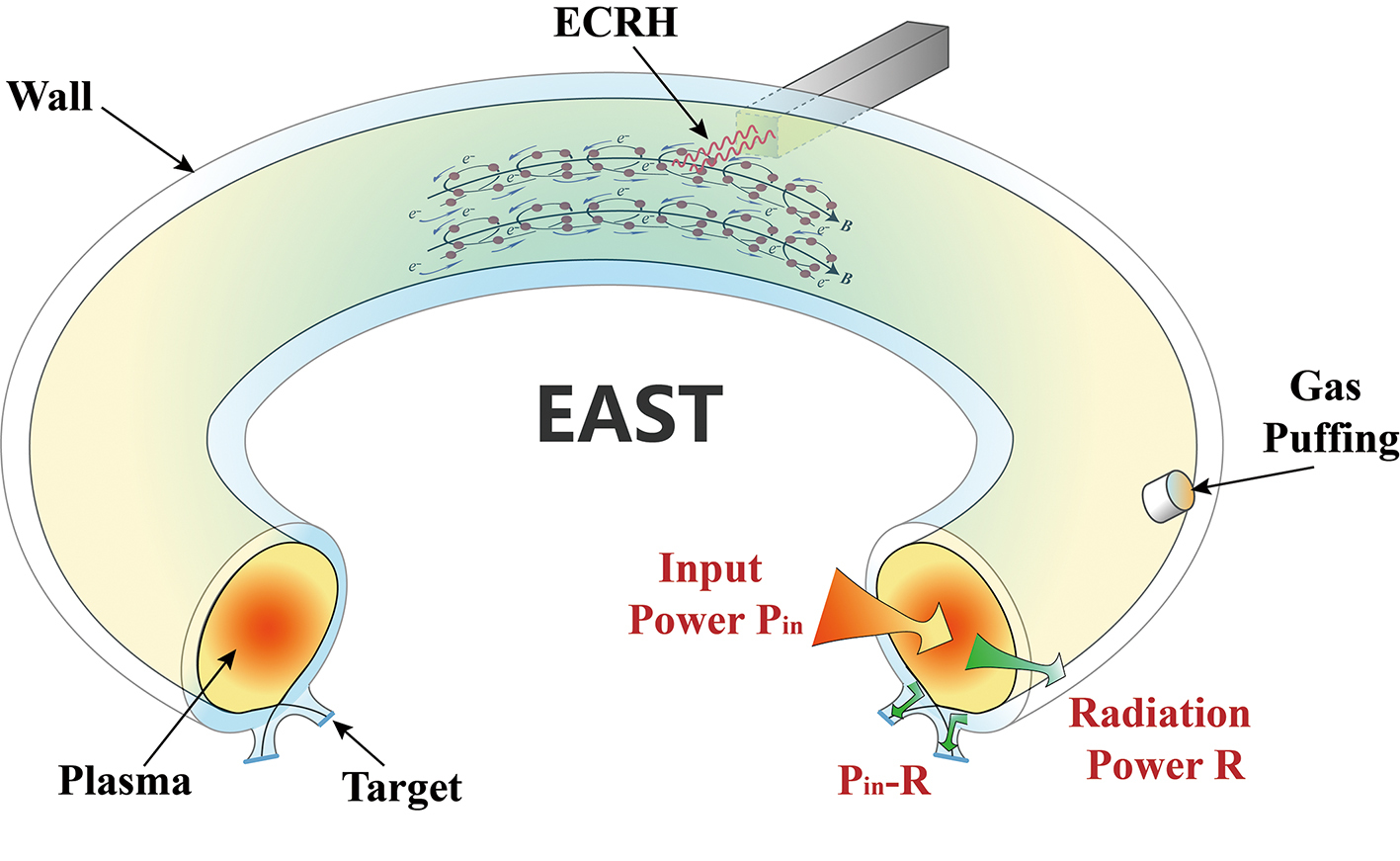
Illustrated is the EAST tokamak during an Ohmic start-up assisted with an electron cyclotron resonance heating (ECRH). (Image: The research team)
Combining different measures, the team further improved the initial plasma purity and efficiently managed the edge radiation to prevent immature disruption. In the end, managing an optimized plasma-wall interaction balance, they achieved a line-average electron density ranging from 1.3 to 1.65 times of GDL, significantly better than the density previously achievable on EAST (between 0.8 to 1.0 times of GDL). The plasma remained stable even when the density went far beyond the empirical limit; and at the end of the star-up, the plasma reached a prime density for fusion ignition.
The experiment results fitted the PWSO model generally well. In this experiment, a high-density regime predicted by PWSO was achieved, verifying the model’s feasibility. Also, the experiment has provided a practical procedure applicable to other magnetically confined fusion devices to raise the plasma density beyond GDL.
The study was jointly led by Prof. ZHU Ping from the Huazhong University of Science and Technology (HUST) and Associate Prof. YAN Ning from ASIPP.
The research team is now embarking on a new journey: They plan to apply the new procedure to high-confinement operation on EAST in the near future, attempting to access the density-free regime under high-performance plasma conditions.
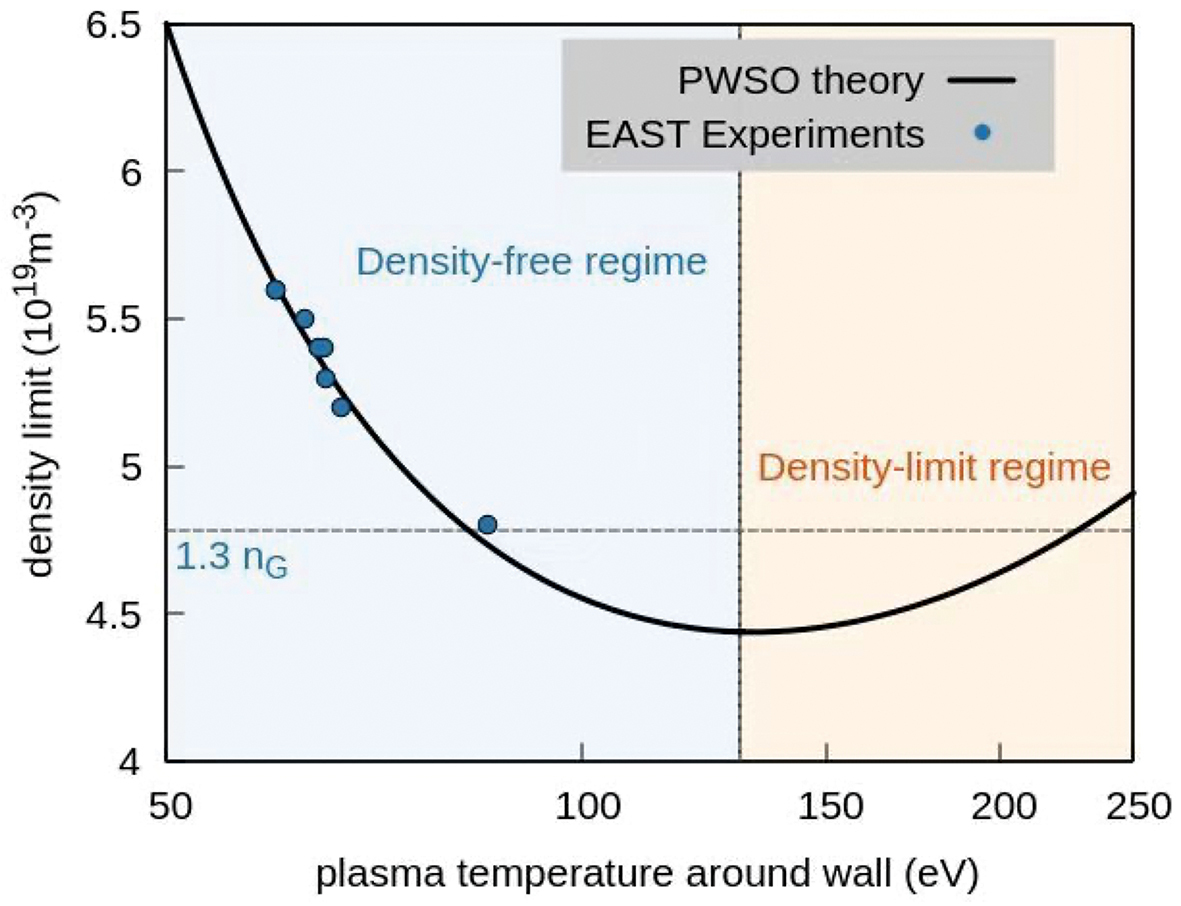
The experiment results of EAST fit the plasma-wall self-organization theory very well. (Image: research team)