

Top 10 News of Overseas S&T Advances for the Year 2025
01. Brain-Computer Interface Enables Emotional Speech & Singing
Amyotrophic lateral sclerosis (ALS) often robs patients of their ability to communicate clearly, leaving them with only the ability to make sounds or mouth movements. While earlier brain-computer interfaces allowed for some text-based communication, they were generally slow and produced robotic, monotone audio. In the summer of 2025, a research team at the University of California, Davis, developed a system that uses artificial intelligence to decode brain waves into expressive speech and even song.
The study, published in Nature, involved a 45-year-old man who had lost intelligible speech due to ALS. The researchers implanted 256 microelectrodes into the region of his brain that controls speech movement. Using deep learning algorithms to capture signals every 10 milliseconds, the system translates neural activity into audio almost instantaneously. Unlike earlier models that required seconds to process output, or could only output audios when the subject imitated a complete sentence, this new technology mimics the user’s own voice and captures nuances like intonation, stress, and pitch. It could respond with voice within 10 milliseconds after the subject’s neural system signaling an intention to talk. The participant was able to converse naturally and even sing, marking a significant leap toward restoring fluid, human connection for people with severe speech impairments.
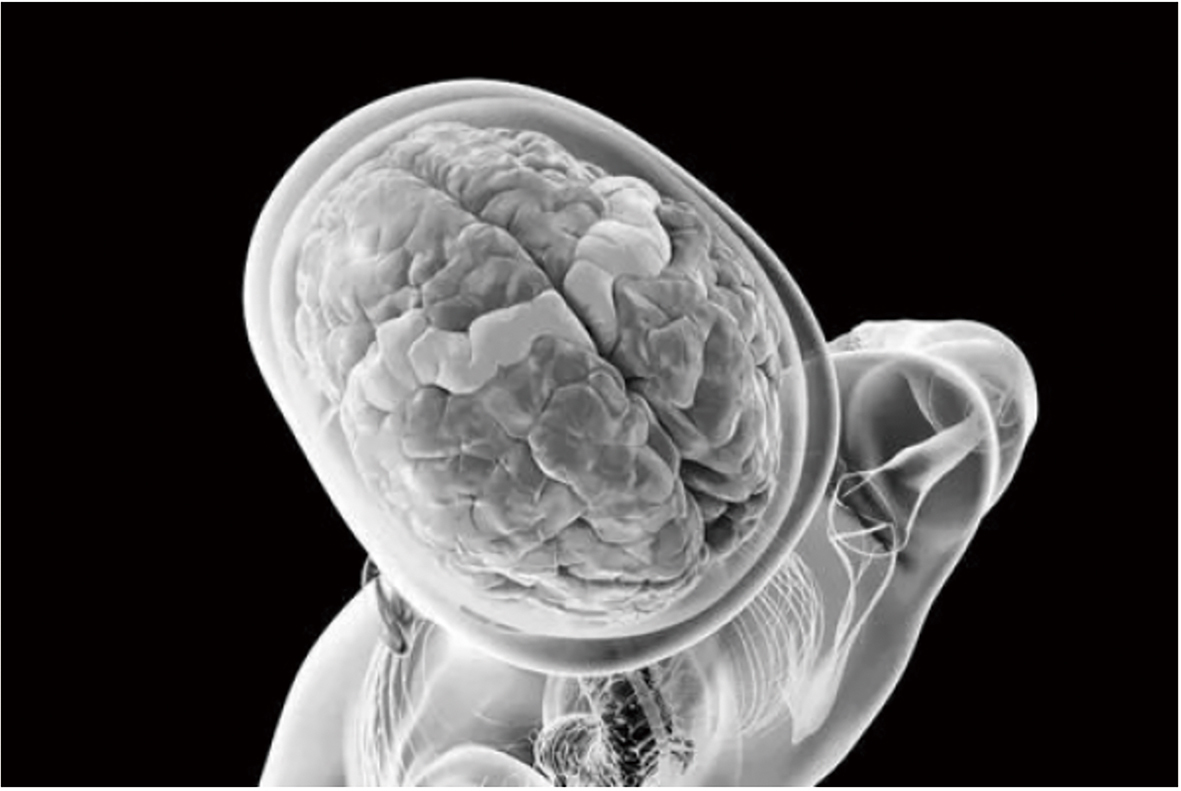
Electrodes implanted in the motor cortex help recording brain activity related to speech. (Graphic: Kateryna Kon)
02. “Electro-Photo-Quantum” Trinity Chip
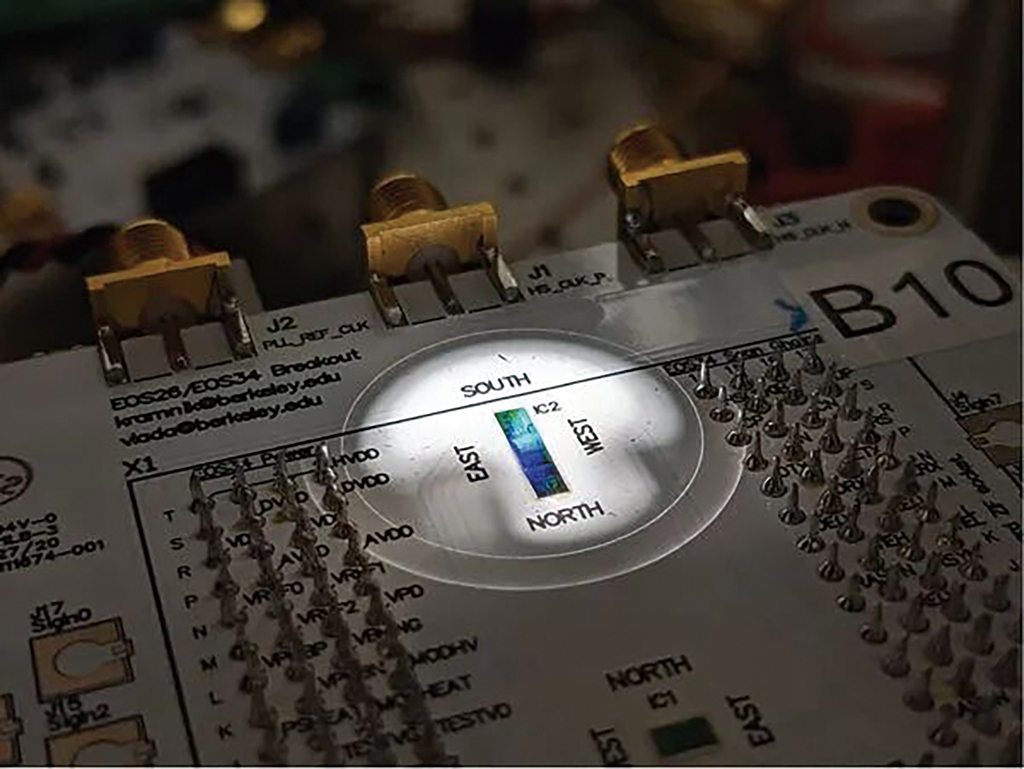
In an experiment, the packaged circuit board with the chip mounted is tested under a probe station microscope. (Image source: Boston University, USA)
On July 17, 2025, a joint team from Boston University, the University of California, Berkeley, and Northwestern University reported in Nature Electronics their successful development of the world’s first “electro-photo-quantum” integrated chip system. This marks the first time that quantum light sources and stable control electronic circuits have been integrated on a single chip, using a standard 45-nanometer semiconductor manufacturing process, laying the foundation for the mass production of “quantum light factory” chips and the large-scale construction of quantum systems.
Just as traditional electronic chips rely on electric current and optical communication systems on lasers, future photonic quantum technologies will also need a stable source of “quantum light” to enable computation, communication or sensing. To this end, the researchers built a set of “quantum light factories” on a silicon chip, each only about 1 square millimeter in size, yet capable of stably generating pairs of correlated photons—the key resource for quantum information applications.
A key challenge in this work was to confine the design of photonic devices within the strict specifications of commercial complementary metal-oxide-semiconductor (CMOS) platforms while preserving their quantum optical performance. This required the team to co-design electronics and quantum optics as a unified system from the outset. The chip, based on a standard 45-nanometer CMOS platform, features a built-in feedback stabilization mechanism that can effectively manage disturbances caused by temperature variations and manufacturing errors.
03. Detection of the Most Massive Blackhole Binary to Date, Challenging Blackhole Formation Models
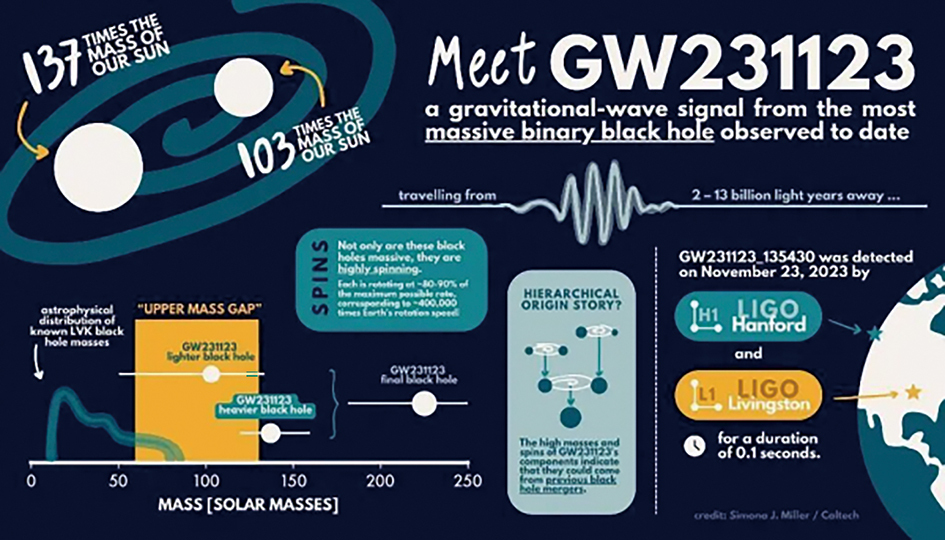
Illustration of the merger process of the binary black hole GW231123. (Image credit: California Institute of Technology)
The LIGO-Virgo-KAGRA (LVK) Collaboration observed the heaviest blackhole merger ever detected. Joining three major gravitational-wave detectors, the collaboration picked up signals from two merging giants. The two, approximately 100 and 140 times the solar mass, respectively, finally coalesced into a single black hole about 225 times massive as our Sun. Designated GW231123, the source was first caught on November 23, 2023 during the fourth LVK observing run.
This discovery was officially announced on July 14, 2025, at the 24th International Conference on General Relativity and Gravitation (GR24) and the 16th Eduardo Amaldi Conference on Gravitational Waves, held in Glasgow, Scotland.
This discovery challenges conventional theories about how blackholes grow. The two original black holes kept spinning rapidly, at a rate of about 40 times per second, approaching the theoretical stability limit. Their masses go far beyond predictions given by standard stellar evolution theories. Blackholes are classified into three categories: stellar-mass (a few to 100 times the mass of the Sun), intermediate-mass, and supermassive, with intermediate-mass black holes being extremely rare. The masses of the black holes in this merger are close to or exceeding the stellar-mass range, and their formation cannot be explained by the traditional supernova explosion mechanism. Judging from their rapid spins, experts speculate that they might have grown from smaller blackholes through successive mergers. This has provided a new perspective for studying blackhole formation.
04. Discovery of the Most Energetic Neutrinos to Date, 20 Times the Energy Previously Detected
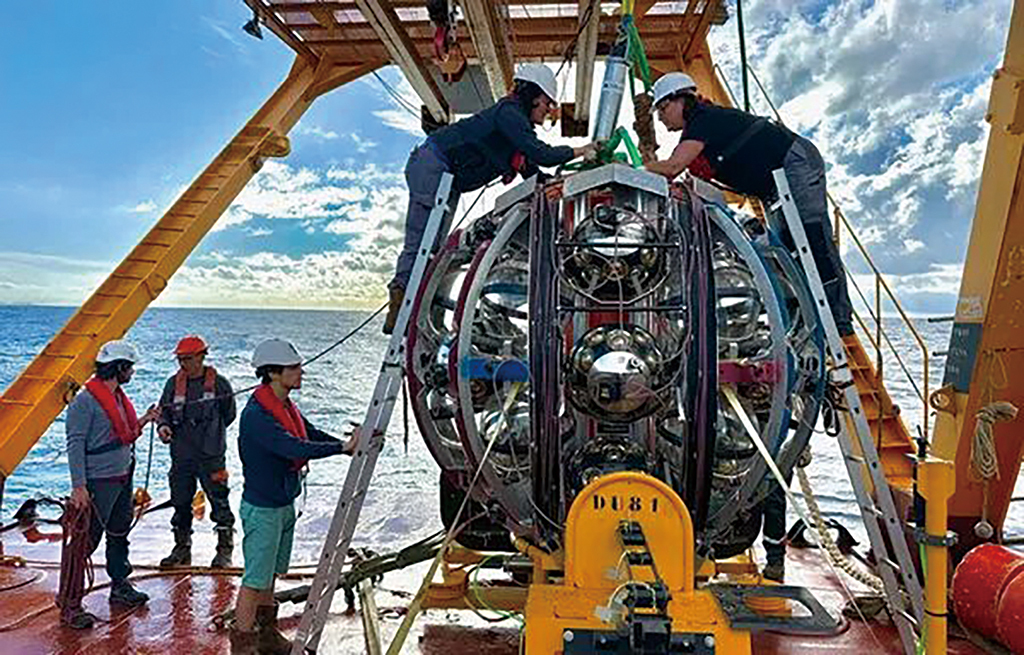
Engineers prepare to install a detector into the underwater KM3NeT network. (Image credit: Paschal Coyle CNRS)
The KM3NeT (Cubic Kilometre Neutrino Telescope) collaboration from Europe published a paper in Nature on February 11, 2025, announcing the detection of the most energetic cosmic neutrinos ever recorded. The researchers believed that these particles have originated outside the Milky Way, though their exact source remains unknown.
On February 13, 2023, the Astroparticle Research with Cosmics in the Abyss (ARCA) detector picked up the signal of a high-energy muon. Researchers estimated the particle had an energy of approximately 120 petaelectronvolts (PeV, 1 PeV = 1015 eV), and the neutrino that produced this muon possessed even higher energy, around 220 PeV. The particle passed through the entire detector and triggered signals in more than one-third of the active sensors. The tilt of its trajectory and the enormous energy provides strong evidence that the muon originated from a cosmic neutrino interacting nearby with the detector. This event has been named KM3-230213A.
Certain high-energy astrophysical events in the universe, such as the accretion of supermassive black holes at the centers of galaxies, supernova explosions, and gamma-ray bursts, remain not fully understood to this day. These events generate flows of cosmic ray particles, and some cosmic rays may interact with matter or photons surrounding their sources, thereby producing neutrinos and photons. During their propagation, such most energetic cosmic rays may also interact with photons of the cosmic microwave background radiation, giving rise to ultra-high-energy neutrinos.
05. The World’s First Visually Observable Time Crystal Created

The time crystal in the lens of a microscope. (Image: Nature Materials)
The time crystal is a form of matter that repeats periodically in the time dimension, just as how atoms are arranged in a repeating spatial pattern in ordinary crystals. Previously, time crystals only existed in complex quantum matter, but physicists have developed a method to create a time crystal visible to the naked eye under specific conditions.
As published in Nature Materials on September 4, 2025, the research involved rod-shaped liquid crystal molecules possessing both liquid and solid properties. By simply shining light on the liquid crystal, the researchers generated ripples that twisted the molecules on its surface. These ripples continued to move at varying rhythms for hours, despite the changed external conditions. Such rhythms were not synchronized with any externally applied force, meeting the two core defining criteria for a time crystal.
In 2012, Frank Wilczek, a Nobel laureate in Physics, first proposed the concept of a time crystal. The time crystal as Wilczek envisioned resembled a perpetual motion machine—a substance that could cycle infinitely in a naturally stationary state. Although a research team mathematically disproved Wilczek’s idea in a paper, researchers soon figured out that there might exist other types of time crystals. For instance, ordered time crystals can exist in special systems that are in constant change rather than in rest. The renewed concept of time crystal is now made real.
These thin time crystal films, the researchers said, can be embedded in banknotes for anti-counterfeiting verification. When light passes through multiple sets of such time crystals each with distinct characteristic patterns, the researchers explained, not only unidirectional ripples but also dynamic two-dimensional barcodes could be produced. Such barcodes are extremely difficult to counterfeit, and can also be used for information storage.
06. Record Long Pig Kidney Survival in Human
A genetically modified pig kidney, transplanted along with the animal’s thymus gland, functioned normally for a record 61 days in a brain-dead human recipient—the longest survival yet for a pig organ in a person. The researchers successfully reversed immune rejection episodes twice using standard treatments, marking the success in overcoming the human rejection of a pig xenograft for the first time.
In two studies published in Nature on November 13, 2025, a team led by surgeons at NYU Langone Health transplanted a single-gene-edited pig kidney (with α1,3-galactosyltransferase knockout to reduce immediate rejection) into a 57-year-old brain-dead man whose own kidneys had been removed. Attached under the kidney’s capsule was thymic tissue from the same pig—an approach known as a thymokidney. The thymus, a gland that educates immune cells to distinguish self from foreign, appeared crucial in moderating the human immune response. By the study’s end, human immune cells were developing in the pig thymus, and tests showed recipient T cells reacting less aggressively to pig antigens.
The kidney produced urine, balanced electrolytes, filtered drugs, and maintained complex functions like protein retention throughout the planned 61-day monitoring period. Early immune activity involved natural killer cells and antibody deposits but did not impair function until day 33, when antibody-mediated rejection struck. Doctors treated it successfully with conventional immunosuppression, later addressing a mixed rejection episode.
In recent years, around a dozen living patients have received genetically modified pig organs—hearts, kidneys, livers, or thymuses—but most failed quickly due to rejection or loss of function. Previous brain-dead recipient studies saw pig kidneys survive only weeks. The thymus co-transplant, building on decades of primate research, restrained attacks and may have prevented protein loss that plagued prior attempts.
Robert Montgomery, director of the NYU Langone Transplant Institute and lead surgeon, highlighted the thymus’s role in promoting tolerance, noting superior outcomes in animal models with thymokidney versus kidney alone. Co-developer Megan Sykes from Columbia University emphasized its potential to reduce long-term rejection risks. While challenges remain—including unidentified pig antigens triggering antibodies and infection risks from immunosuppression—the findings provide critical insights into immune mechanisms and pave the way for safer clinical xenotransplants to address organ shortages.
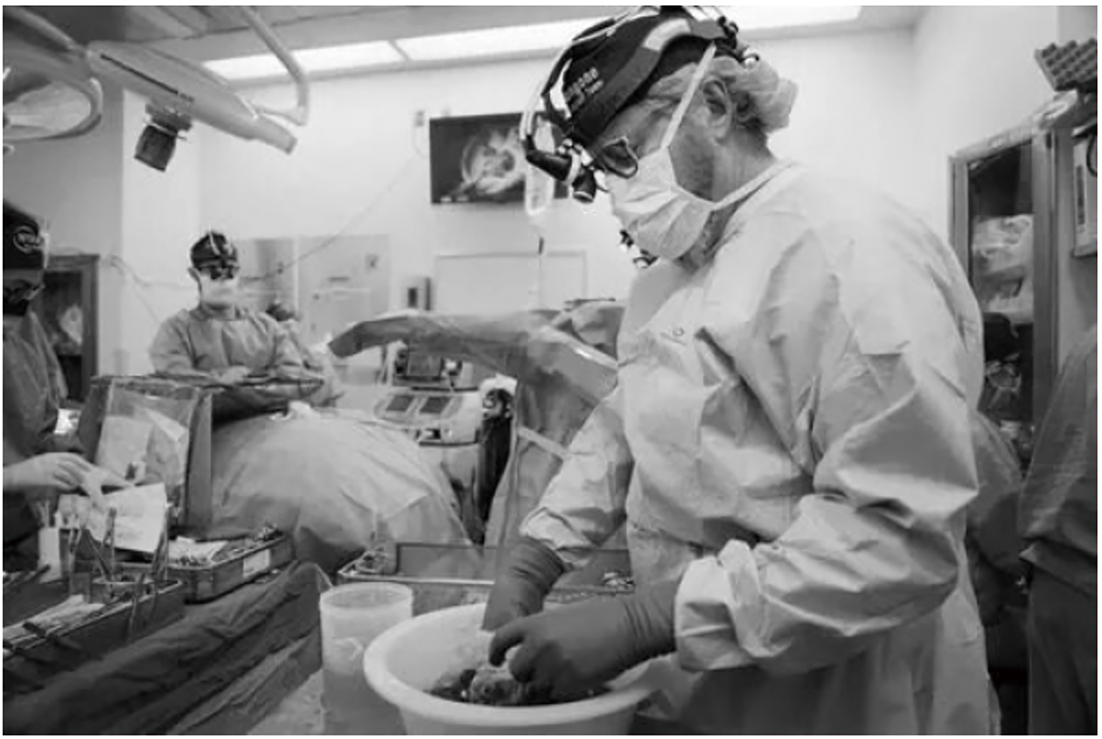
In July 2023, Robert Montgomery prepares to transplant a pig kidney into a brain-dead man in New York. (Graphic: Shelby Lum)
07. Ground-Based Telescope Detects Cosmic Signals from 13 Billion Years Ago for the First Time
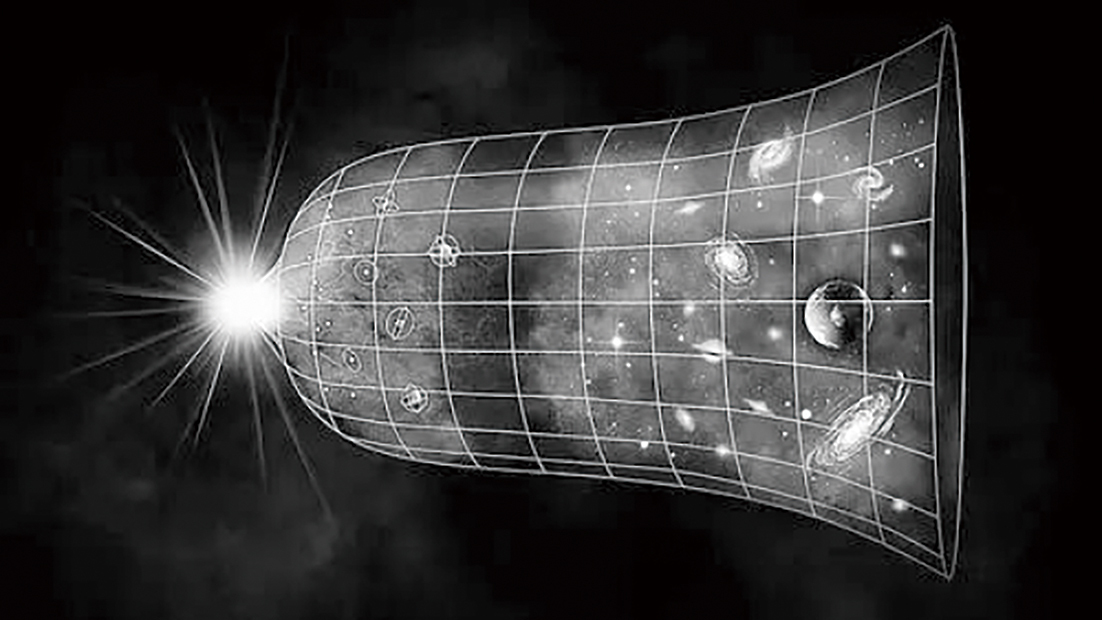
Scientists used a telescope in Chile to detect light scattered by the universe’s first stars, offering new insights into the early cosmos. (Image credit: Shutterstock)
Scientists from Johns Hopkins University and the University of Chicago used a ground-based telescope located high on the Andes Mountains of Chile to observe polarized microwave signals from the early universe. Published in The Astrophysical Journal on June 11, 2025, this marks the unveiling of the mysterious look of the infant cosmos, from a time just a few hundred million years after its birth, by a ground-based instrument for the first time. This is an extremely critical yet largely uncharted era in astronomy, known as the Cosmic Dawn.
Such signals were once though only observable by space telescopes. Cosmic microwaves are extremely weak, and their polarized signals are just one millionth of their intensity. Even worse, radio interference, atmospheric disturbances, weather changes and other factors on the ground can mask or distort their signals. Therefore, such observation missions have long been carried out by satellites in space. However, the Cosmology Large Angular Scale Surveyor (CLASS) project has achieved this groundbreaking measurement on the ground with a uniquely designed ground-based telescope.
The researchers explained that the universal signal they discovered this time is like a cosmic-scale “glare,” revealing how light from the Cosmic Dawn was scattered. They compared and analyzed CLASS data with past observations by satellites to identify sources of interference and narrow down the range of the common signals from the Cosmic Dawn.
This study not only helps scientists more precisely define the signal of the epoch of reionization in the cosmic microwave background radiation, but also provides a clearer picture of the early universe.
08. The Largest Cosmic Map to Date
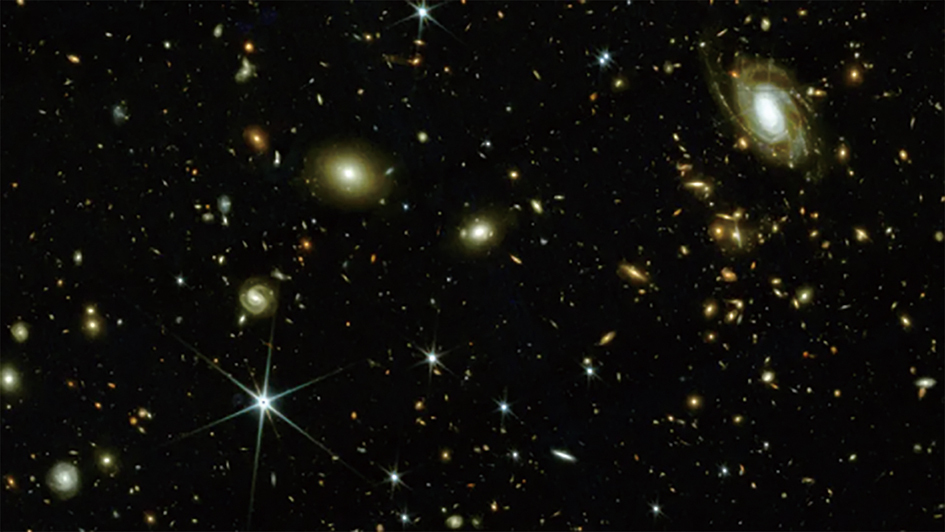
A snapshot of the sky from the COSMOS-Web interactive catalogue. (Image credit: COSMOS-Web)
On June 6, 2025, an international research team officially released the largest cosmic map to date, together with all associated observational data. Named COSMOS-Web, the map is built from data collected by the James Webb Space Telescope (JWST), encompassing more than 780,000 galaxies and spanning 13.5 billion years—98% of the entire cosmic history. These data are challenging human understanding of the early universe.
The COSMOS-Web map traces back to about 300 million years after the Big Bang, when the first stars shed their first light. The number of ancient galaxies captured by JWST far exceeds expectations. Astronomers once thought that galaxies would be extremely rare within the cosmos’ first 500 million years, yet JWST discovered 10 times more galaxies of this period than Hubble did. More surprisingly, the team also detected several supermassive blackholes—celestial bodies that were completely undetectable in the Hubble era.
These findings challenge the current cosmic evolution model. It was previously believed that forming a galaxy with a mass of one billion suns would take at least several hundred million years, but the new data indicate that the universe seemingly formed a large number of stars and complex structures in just a few hundred million years. Still, further detail is to be researched and analyzed.
09. Largest Brain Map Details Intricate Synapse-Level Architecture of Intelligence
Mapping the precise connections of the brain has long been considered an insurmountable challenge in neuroscience. In 1979, molecular biologist Francis Crick famously stated that it would be impossible to create an exact wiring diagram for even a single cubic millimeter of brain tissue. However, a collaborative team of researchers from Baylor College of Medicine, Stanford University, the Allen Institute, and Princeton University has turned that impossibility into reality.
In April of 2025, the scientists published a suite of studies in Nature and its sister journals under the collection of “The MICrONS Project” —detailing the largest and most comprehensive functional map of a mammalian brain to date. The project, known as MICrONS, focused on a one cubic millimeter section of a mouse visual cortex. The team first recorded neural activity while the mouse watched videos, then sliced the tissue into 25,000 ultra-thin layers for electron microscopy. Using artificial intelligence to reconstruct the 3D volume, the resulting map contains over 200,000 cells, 4 kilometers of axons, and 523 million synapses—the connection points between cells. This 1.6-petabyte dataset reveals that inhibitory cells are not random suppressors of activity but part of a highly selective, coordinated network. Comparable in significance to the Human Genome Project, this resource provides a foundation for decoding the physical structure of intelligence.
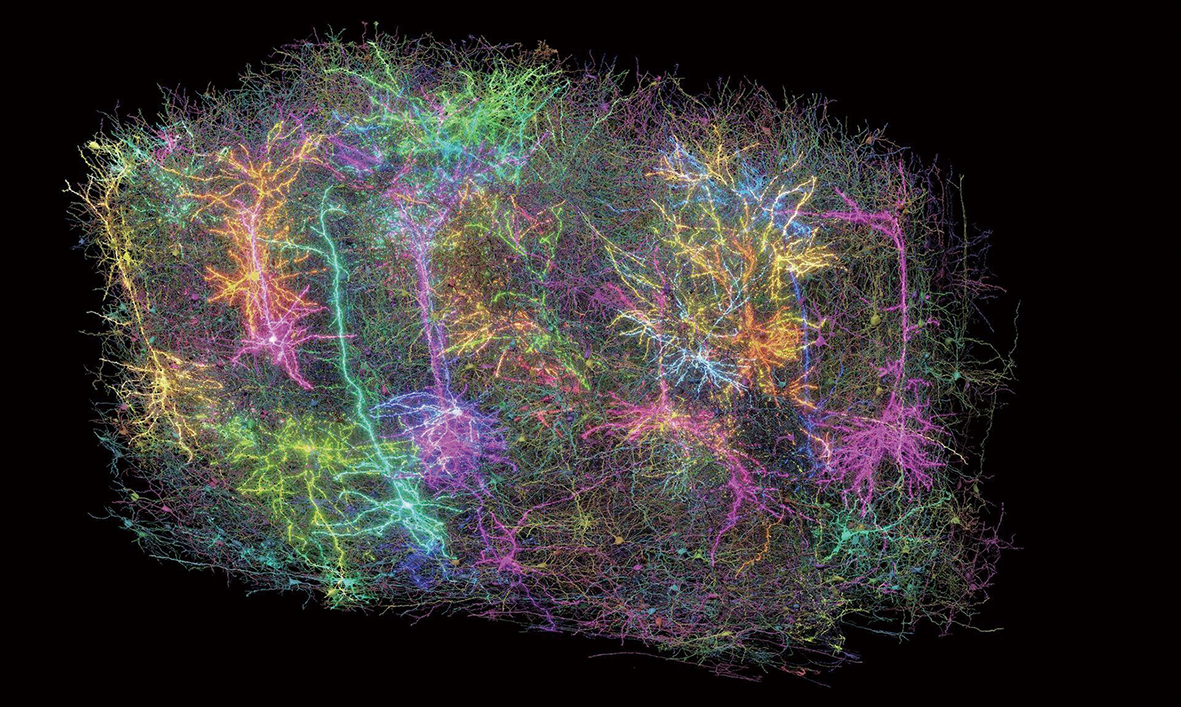
A rendering of more than 1,000 brain cells reconstructed from the analysis of a cubic millimeter of mouse brain tissue. (Graphic: Allen Institute)
10. DeepMind’s Gemini Wins the Gold at International Math Olympiad
The International Mathematical Olympiad (IMO) has long be seen as a battle ground for the world’s brightest young mathematical minds. However, in July 2025, the competition witnessed a historic shift when Google DeepMind’s advanced “Gemini” model, equipped with a specialized “Deep Think” capability, achieved a verified Gold Medal standard.
Unlike previous iterations that struggled with complex multi-step reasoning, this version of Gemini successfully solved five out of six problems, securing 35 out of a possible 42 points. This performance significantly outperformed the Silver Medal level achieved by DeepMind’s AlphaProof system in 2024. The model navigated through the four core pillars of the competition—algebra, combinatorics, geometry, and number theory—producing solutions that official IMO judges described as astonishingly clear and precise. The “Deep Think” architecture allows the model to pause and deliberate before generating an answer, effectively simulating human “System 2” thinking. This breakthrough indicates that artificial intelligence has crossed a critical threshold: moving from probabilistic text generation to rigorous, reliable logic. Experts suggest that these enhanced reasoning capabilities will not only transform mathematics education but also serve as a catalyst for automated scientific discovery in physics and engineering.
The Gemini model won gold at the 2025 Math Olympiad. (Illustration generated with AI)